Thinking back on the three trilogies we have studied in class this semester, I’m really glad that each one is from a completely different time period. I would like to look at them comparatively in terms of time, and how these three trilogies may exemplify a genre that is rapidly changing and growing.
When we first started LOTR, we all mostly agreed that Tolkien certainly is a major writer, and also the “father of fantasy”. He was the first author to successfully create a world separate from our own, yet still very complete—introducing new races, languages, and settings that we had never known before.
Most of us agreed that Donaldson’s trilogy mimicked Tolkien’s in many ways. Both introduced new worlds with similar species, a quest involving a ring, an unlikely hero, etc. At the same time, though it didn’t always go over so well, Donaldson made changes and took risks that didn’t exist in Tolkien’s world. For one, Donaldson did not only introduce a new world, but he also included our own and made his protagonist a man from our world. He put an interesting twist on it by also making his character a leper—therefore sparking the reader’s sympathy and interest for Covenant. The biggest advancement Donaldson made within the genre though, at least between these three books, lies in the risky choices made with his main character, Thomas Covenant. Covenant is perhaps the most atypical hero, weakened and sickly from the start. Covenant is also purposely written not just to be an unlikely hero, but also to be completely unliked by readers. Donaldson took the biggest risk in actually having Covenant rape a young girl in the very beginning of his first book—something I don’t think was ever done in fantasy before and especially not before Donaldson’s time.
Finally, I think ‘His Dark Materials’ most fully exemplifies the advances happening in the ever-growing fantasy genre. Unlike the first two series, Pullman’s protagonist is a female, yet still a strong, witty, and convincing lead character. Then, in his second book, Pullman introduces another protagonist quite successfully, something not usually pulled off or even attempted in literature. Pullman’s idea of multiple worlds coincides with a true scientific theory of today, and his mixture of both magic and science supports the idea that the line between science fiction and fantasy is now blurring. Not only this, but Pullman makes religion a major theme of his work, inserting religious opinion in his books blatantly when before religious intent was merely hinted at.
It certainly is interesting to have taken this class in a time where fantasy is still a young and rapidly growing genre, to see firsthand the changes and advances being made through time from author to author.
--Molly G.
Showing posts with label Fantasy Fiction. Show all posts
Showing posts with label Fantasy Fiction. Show all posts
Monday, December 14, 2009

Sunday, December 6, 2009
His Dark Materials Shines a New Light on Things

Growing up Christian and being sent to church and Sunday school every Sunday because it made the grandparents happy left me with a little resentment towards organized religion. I was baptized when I was baby and do not remember it, however when it came time for me to be confirmed and admit my life to one God and one religion, I really had to think about this. I was about to sign my life away to a belief that has yet to be proven or even fully answered. I was faced with a choice that I had to make, one that I could not make lightly either. I had lots of questions that needed answering before I could accept that this was the right thing to do. I never became confirmed because I was never answered with any response that I felt was a legitimate reason for things or for belief, if there was no answer this was the response I received “that is why they call it faith, you don’t question it, you just believe.”

I feel that Pullman, like myself, did not feel that this sort of response was a legitimate response to the questions that arise within organized religions such as the Christian faith. Perhaps the church is right and there is a God, perhaps he is a loving and virtuous God who has sacrificed the ultimate gift so that you and I will have a place in Heaven, or maybe he is that wrathful and full of vengeance as he is portrayed in the Old Testament. Perhaps the latter is true and the question that Pullman asks of whether we have been lied to since the dawn of man.
Perhaps there was extraordinary cataclysmic battle between good and evil at the beginning of the world, but who is to say that right a good side won. I once heard a quote from a history teacher that I had in High School: “History is written by the winner, not the loser.” Although I did not really think about it at the time, but this quote is true. Think about how the idea of Thanksgiving is taught in our schools; as happy time where we think about how our friends the “Indians” taught us about what friendship was and kindness, not even close. Now let’s look at what really happened; we came, we took, we raped, we murdered, we slaughtered, we purposefully infected, we relocated, and now we break treaties and try to implement taxes on these people. 
This misconstrued idea of history has been fed to us since day one because that is how it was recorded. Perhaps that is the same with the Christian religion. Maybe Pullman had thought the same thing and decided to express this idea that maybe God was the really the evil one and that Satan was the good one but he lost and so therefore history was misconstrued and recorded as a lie. I do not think that Pullman is necessarily bashing the Christian faith, but instead presenting a piece of fiction that brings to light new ideas about an ancient history. Maybe the real important thing is to make decisions for ourselves and not blindly following like a sheep.
The Child, Morality, and HDM
 Morality and the justification for character's actions is something that most creative writing students learn within the first week of the introduction class. Every action the character has must be believable in the grand scheme of things. Whether the story is fantasy, science fiction, realism, magical realism, whatever the genre, the decisions the character makes must be justifiable in order for the piece to be believable. This is where the author really shines. He/she can write the story in such a way that those actions are not only justified but are within the character's characteristics.
With children as main characters, the problem becomes complicated. Most of the time children haven't reached the point where they are able to see even the most basic consequences behind their actions, let alone those that are polysemous in nature. This applies not just to the main characters but to the readers who are most likely children readers, drawn to characters most like them. So a decision to steal food, for example, is seen as wrong but justified as being necessary for the survival of the character. Both the reader, who is of the same developmental mindset as the main character, and the child character are subject to the authors views on morality, which even in the most lay adults are much more highly developed than an adolescents'. Thus when the character and the adolescent reader encounters the consequences of the characters mistakes they learn his/her lesson and gain a sense of right and wrong.
Yet what happens when those consequences are not fully present? What happens if the consequences never catch up to the character? A sense of morality is never established in the character and a wrong sense of morality is instilled in the reader, believing that these actions have no consequences. Thus we arrive at Phillip Pullman's His Dark Materials trilogy. As much ridicule this series has been subject to, very rarely do we see any directed toward morality. Many believe that Lyra learns from her moral misgivings, and yes we see Lyra encounter the consequences of her lies toward the middle of The Amber Spyglass, a full 600 pages after her first lie.
For all of The Golden Compass and The Subtle Knife the reader watches Lyra weasel her way out of consequences and walk away none the wiser. She learns how to nurture through Will's missing fingers, how to be a "proper lady" through Coulter, and is told the direction to fulfill her quest through the Golden Compass. She literally grows up in front of our eyes throughout the series without even knowing that her lying, stealing, and hiding are not the right things to do. Yes she has moments of clarity, and boy do they last a long time (about 100 pages through Subtle Knife she is a submissive, comment-less blob with a compass), and yes she does hold the ultimate "truth teller" in her hands that gives her a sense of right and wrong. But these moments are rather lame and few. For all the fantastic writing of Pullman, I believe he guides and establishes reader's, especially those of adolescent mindset, into morally grey if not black territory.
While I could carry on with this post for another three or four days, here is where I will stop and submit to you to email me if you want to see my finished thought…
Wednesday, December 2, 2009
Bring Fantasy Back to the Classroom
Many English teachers face the widespread misconception that if a work of fiction is enjoyable, it cannot be good, or, conversely, if it is good, it cannot be enjoyable. Critics of fantasy, for example, would likely argue that better reading materials are available for students to read. The inclusion of materials other than the “classics” into the curriculum, however, should not depend only on “literary worth” but also on what benefits the adolescent reader gets from the reading experience.
Typically when teachers consider using fantasy novels in the classroom, they do not envision it being used at the secondary level as it is typically dismissed as “childish” and unworthy of serious literary criticism; in fact it is questioned how a novel about dragons and magic can convey any of the same themes and ideas as Shakespeare or Dickens. Fantasy tends to be ignored by teachers, parents, and administrators who feel that certain classics from the typical literary canon should be read. When students are prepared for the Eleventh Grade NYS Regents ELA, the canon of works that will help them in the critical lens portion of the exam range from Arthur Miller’s The Crucible to John Steinbeck’s Of Mice and Men and from Nathaniel Hawthorne’s The Scarlet Letter to Harper Lee’s To Kill a Mockingbird. Of course we are not forgetting any of the great Shakespearean works such as Hamlet, Romeo and Juliet, Macbeth, or Julius Caesar. Each of these works is indeed a masterpiece about tragedy, triumph, and the inner conflict of humanity. However, the genre of fantasy can address these deep human issues as well as many others such as the impossibility of certainty, the complexity of action, and the coexistence of good and evil.
It is helpful to come to a definitive definition of fantasy as a genre of literature in order to understand why it is so beneficial. This is no easy feat in and of itself. Many authors and critics have developed various definitions of the term but a common thread in them all is that fantasy must include an element that is removed from reality. Fantasy is often characterized by a departure from the accepted rules by which individuals perceive the world around them; it represents that which is impossible (unexplained) and outside the parameters of our known reality. For the sake of argument we will be looking at the most comprehensive and inclusive definition. It comes from the classic reference text in order to best provide the broadest sense of this misunderstood genre. From the Encyclopedia of Fantasy, by editors John Clute and John Grant, sets the definition for fantasy as we know it. “A self coherent narrative that when set in this world tells a story that is impossible in the world as we perceive it; when set in an otherworld, while it is impossible in itself, stories set there may be possible in its terms”. Clute and Grant go on to further define subgenres and types of fantasy showing that the genre is more complex than misconceptions allow. In a nutshell, fantasy is any departure from reality and within can contain many elements ranging from other worlds to supernatural powers to fantastic creatures.
It is important to note that characteristics of fantasy fiction and its many overlapping sub-genres are the subjects of debate among some critics and writers. Although all fantasy stories are unique, there are some characteristics that are typically common of the genre. Fantasy brings many elements to the table that will help students prepare for the Regents ELA exam. In general, the conflict in fantasy novels is of good vs. evil. Usually, the protagonist and supporting characters set out to conquer this evil, although this is often played out through a series of books, rather than just one. Most fantasy fiction also features great details, with settings, creatures, words and names that are often created by the author. Fantasy novels require their audiences to read carefully, for their settings and characters are not familiar in everyday life. In recent times, the term 'fantasy', when regarded as part of an individual genre, generally brings to mind tales of dragons and castles and knights in shining armor - but in truth, the genre as a whole encompasses so much more. Some examples of sub-genres are: romance, fairy tales, alternative history, dark fantasy, epic fantasy, and high fantasy to name a few.
Fantasy literature allows the reader to consider and speculate about central and sometimes painfully realistic themes, in a way that is more palatable than in realistic fiction. One thing is certain: there is something timeless about stories that pit motivating heroes who face long odds against dynamic villains. The fantastic nature of the characters and the setting provides readers with emotional distance that gives them room to consider sensitive and important ideas more objectively than any other genre. An irony about fantasy is that despite the fanciful characters, strange imaginary worlds, and bizarre situations encountered, it has the power to help us better understand reality. Who wouldn't want something so powerful to be included in curriculums?
Friday, November 27, 2009
A Ring, A Compass, and... A Cat?
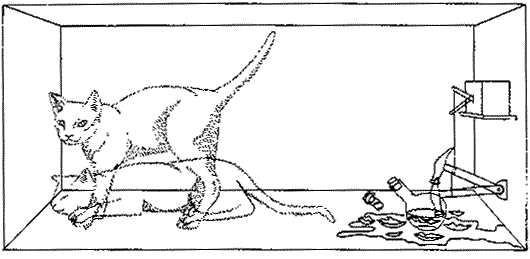
One of the very cool things that the His Dark Materials trilogy can do is really open up your imagination. The multiple worlds theory is one of the more interesting and applicable ideas in fantasy, spawning new ways to look at your favorite worlds. Anyone hear of the Schrödinger's cat paradox? The paradox states that every event is a branch point; for example if a cat is placed in a box for a day and dies, that only means it is dead in our universe. The cat is both alive and dead, even before the box is opened, but the "alive" and "dead" cats are in different branches of the universe, both of which are equally real, but which cannot interact with each other. So I started thinking about death in fantasy and how, according to Pullman, there a several universes in the HDM trilogy.
(rhetorical question) Is death an obstacle if the multiple worlds’ theory is used fantasy?
Contrary to the literature for LOTR, I believe Tolkien used this theory in Middle Earth. Gandalf fights the Bellrock and is mortally wounded doing so. He eventually dies of these wounds yet the “order” brings Gandalf back to life. The new White Wizard returns to fight for the fellowship and to destroy the ring. We all know of this, yet what realm does the order exist in and why does Gandalf feel like the years have passed by him? The simple explanation of this is that he spends time in heaven and then returns back a new man/wizard. But I’m gonna put a new twist on this idea. The White Wizard Gandalf might not be from the Middle Earth that the grey Wizard died in. On page 484 of the Two Towers in my book there is this quote:
“’Yes I am white now,’ said Gandalf... ‘But come now, tell me of yourselves! I have passed through fire and deep water, since we parted. I have forgotten much that I thought I knew, and learned again much that I had forgotten. I can see many things far off, but many things that are close at hand I cannot see. Tell me of yourselves!’”
 Now, while there are many who read into this passage, and the passage on page 491 saying that he was “sent back naked,” believing that he was sent back from heaven to complete his job. However, what is heaven in this story but another dimension, another world that is layered upon Middle Earth? (Disregarding the Silmarillion that was published in Tolkien’s name post-humorously and was never fully described by Tolkien the way he intended, and forget about Iluvatar and the stories about his creation.) Taking into account the Schrödinger's cat paradox, this “Heaven” may just be a place where Gandalf never died. The Gandalf the White present in the Two Towers conveniently cannot remember specifics to come but knows the outcome now that he is here. He had to learn about the death of Boromir and the breaking of the fellowship from Galadriel because, in his universe with him present, Boromir may have never died and the fellowship was probably together. He may have created a crack in time and space and walked through to around the time he came close to death, knowing about multiple dimensions. This is a very “what if” scenario but nonetheless it is an enlightening experience when you think about.
 Anyone else think this might be an option?
Tuesday, November 24, 2009
Is Donaldson's Chronicles of Thomas Covenant worth the paper it's printed on?
It's no big secret that I am not a fan of Stephen Donaldson. I do not really consider him a major author and if could go back in time and stop myself from reading the Chronicles of Thomas covenant I probably would. What I am wondering is if this series has any redeeming qualities whatsoever or if the world would just be a better place without it.
One thing that I can see the author was trying to achieve was to defy the conventions of fantasy by making the main character a kind of anti-hero. So we get Thomas Covenant, a cynical leper who is constantly complaining and doubting the fantasy world that he finds himself in. This is a somewhat interesting concept and in the very beginning of the first book of the series I was actually intrigued but as the story wore on the combination of Covenant's character and Donaldson's narrative style killed my interest.
Why Donaldson chose to narrate an epic fantasy with an annoying anti-hero protagonist in a close third person perspective? I can't say for sure. Why no one read an initial draft of his manuscript and told him he might want to rethink the perspective? Perhaps an even bigger mystery. I think that in using a limited third person perspecive, Donaldson was trying to highlight Covenant's internal conflict in his constant doubt in the Land's existance. In my opinion the ends did not justify the means with this choice and for a number of reasons.
First and foremost that conflict was not all that compelling to me in the first place. I think that it is warrented for Covenant to doubt the Land at first based on his history with the leprosarium and the way that he has had to train himself to become incredibly grounded in reality. After a while though Covenant's constant doubt in the Land just got annoying to me. Even if he believed it was a dream why not just run with it? Moreover it seemed that with the close third person perspective, Donaldson was attempting to extend this disbelief to the reader as well as the character which for me just did not work. The willing suspension of disbelief by the reader is not just a conventino of fantasy but a convention of all fiction. I think that for the most part to subvert this convention is to write bad fiction. The "it was all just a dream after all" ending is a cliché so I don't see why leading the reader to believe that might be coming is a good thing. I would have rather seen Donaldson construct a compelling world that I could become invested in rather than have him constantly try to make me doubt the world that he did present.
Another complication that arose from the close third person narratative style is the way that exposition is handled. The world building element of fantasy fiction requires a great deal of exposition and the use of limited third person perspective only allows the author to deliver that information through things that the main character observes. One way that Donaldson deals with this problem is to jam as much exposition into dialogue as possible. The result is that characters use unnatural voices to essentially talk at the reader and provide them a comprehensive history of the Land. What Donaldson can't force into exposition he deals with through Thomas Covenant's uncanny perceptions of the world around him. To some extent this may be warrented as Covenant is a former writer but I think that the inferences that the narrator makes through Covenant become excessive to the point where it takes the reader out of the story.
So is the seires worth the paper it's printed on? Maybe I'll give it that but it's definately not worth the ink. That stuff is expensive.
One thing that I can see the author was trying to achieve was to defy the conventions of fantasy by making the main character a kind of anti-hero. So we get Thomas Covenant, a cynical leper who is constantly complaining and doubting the fantasy world that he finds himself in. This is a somewhat interesting concept and in the very beginning of the first book of the series I was actually intrigued but as the story wore on the combination of Covenant's character and Donaldson's narrative style killed my interest.
Why Donaldson chose to narrate an epic fantasy with an annoying anti-hero protagonist in a close third person perspective? I can't say for sure. Why no one read an initial draft of his manuscript and told him he might want to rethink the perspective? Perhaps an even bigger mystery. I think that in using a limited third person perspecive, Donaldson was trying to highlight Covenant's internal conflict in his constant doubt in the Land's existance. In my opinion the ends did not justify the means with this choice and for a number of reasons.
First and foremost that conflict was not all that compelling to me in the first place. I think that it is warrented for Covenant to doubt the Land at first based on his history with the leprosarium and the way that he has had to train himself to become incredibly grounded in reality. After a while though Covenant's constant doubt in the Land just got annoying to me. Even if he believed it was a dream why not just run with it? Moreover it seemed that with the close third person perspective, Donaldson was attempting to extend this disbelief to the reader as well as the character which for me just did not work. The willing suspension of disbelief by the reader is not just a conventino of fantasy but a convention of all fiction. I think that for the most part to subvert this convention is to write bad fiction. The "it was all just a dream after all" ending is a cliché so I don't see why leading the reader to believe that might be coming is a good thing. I would have rather seen Donaldson construct a compelling world that I could become invested in rather than have him constantly try to make me doubt the world that he did present.
Another complication that arose from the close third person narratative style is the way that exposition is handled. The world building element of fantasy fiction requires a great deal of exposition and the use of limited third person perspective only allows the author to deliver that information through things that the main character observes. One way that Donaldson deals with this problem is to jam as much exposition into dialogue as possible. The result is that characters use unnatural voices to essentially talk at the reader and provide them a comprehensive history of the Land. What Donaldson can't force into exposition he deals with through Thomas Covenant's uncanny perceptions of the world around him. To some extent this may be warrented as Covenant is a former writer but I think that the inferences that the narrator makes through Covenant become excessive to the point where it takes the reader out of the story.
So is the seires worth the paper it's printed on? Maybe I'll give it that but it's definately not worth the ink. That stuff is expensive.
Streets Paved in Gold..The Stuff Fantasy is Made Of
American pop culture has evolved in many strange and unique ways over the years. From hula hoops to pet rocks, Jane Fonda to Tae-bo, fads come into favor as quickly as they burn out. One thing that stays popular year after year are fantasy novels.
From vampires to magic and everything in between, fantasy writing is one of the few genres that can appeal to virtually every person. All you need is a subject you enjoy and the ability to suspend your disbelief and you are on your way to enjoying all the worlds of fantasy.
If you can dream it up, you could create a fantasy novel about it. Grab any New York Times bestseller list from any week over the past ten years, and you will find at least one fantasy novel listed. With all the rigors and stresses of day to day life, being able to take some time away and immerse yourself into a fun and exciting world brings joy and comfort to millions every day.
So what is it about fantasy novels that allows them to maintain their popularity year after year? While there are as many answers as fantasy fans, the universal trait common among all fantasy novels is great storytelling. As a writer, if you are going to create an entirely new world, one that can have a few or many physical laws that do not apply in the real world, you have to be able to be able to convey those laws in words alone. All of the greatest, epic fantasy works do a great job of conveying unusual concepts while not losing track of the flow of the story. Robert Jordan was one of the masters of this. Being able to describe a group of characters who have the ability to control the basic elements (air, fire, earth, water, and spirit) and still being able to move the story along without losing many readers, creates a world that is far enough of a departure from reality to allow the reader to be whisked away and leave their cares alone. Anne Rice created her supernatural world of vampires which introduced an entire generation to the underside of society and the dark corners of the human soul. David Eddings successfully combined fictional theology with his "the will and the word" to create a world that was both pure fantasy while still grounded in reality. Anne McCaffery brought us a new insight into humanity on the backs of dragons.
Given enough time, every person can get bogged down with their routine in such a way that it seems mundane. Fantasy novels give them an escape. A chance to dream like a child again. A chance to imagine themselves as a cast member in the theatre of the mind that a great fantasy novel creates. For this reason, as long as there are books to be written, fantasy is a genre that will be at the forefront of the publishing world, because America was built on fantastical dreams.
From vampires to magic and everything in between, fantasy writing is one of the few genres that can appeal to virtually every person. All you need is a subject you enjoy and the ability to suspend your disbelief and you are on your way to enjoying all the worlds of fantasy.
If you can dream it up, you could create a fantasy novel about it. Grab any New York Times bestseller list from any week over the past ten years, and you will find at least one fantasy novel listed. With all the rigors and stresses of day to day life, being able to take some time away and immerse yourself into a fun and exciting world brings joy and comfort to millions every day.
So what is it about fantasy novels that allows them to maintain their popularity year after year? While there are as many answers as fantasy fans, the universal trait common among all fantasy novels is great storytelling. As a writer, if you are going to create an entirely new world, one that can have a few or many physical laws that do not apply in the real world, you have to be able to be able to convey those laws in words alone. All of the greatest, epic fantasy works do a great job of conveying unusual concepts while not losing track of the flow of the story. Robert Jordan was one of the masters of this. Being able to describe a group of characters who have the ability to control the basic elements (air, fire, earth, water, and spirit) and still being able to move the story along without losing many readers, creates a world that is far enough of a departure from reality to allow the reader to be whisked away and leave their cares alone. Anne Rice created her supernatural world of vampires which introduced an entire generation to the underside of society and the dark corners of the human soul. David Eddings successfully combined fictional theology with his "the will and the word" to create a world that was both pure fantasy while still grounded in reality. Anne McCaffery brought us a new insight into humanity on the backs of dragons.
Given enough time, every person can get bogged down with their routine in such a way that it seems mundane. Fantasy novels give them an escape. A chance to dream like a child again. A chance to imagine themselves as a cast member in the theatre of the mind that a great fantasy novel creates. For this reason, as long as there are books to be written, fantasy is a genre that will be at the forefront of the publishing world, because America was built on fantastical dreams.
Tuesday, November 17, 2009
Fantasy and science fiction
I don't read much fantasy books, unless like the Twilight Saga count. Which could be debatable in that vampires are not real and that they are mythical creatures, same as the wolves that are in the book. Fantasy even though is not as popular as other genres it is defiantly on the rise with the popularity of "Harry Potter" and "Twilight". The making of these movies is also very helpful, fantasy movies are on the rise.
Fantasy i have found after reading "Lord of the Rings" is a great way to use the imagination because fantasy isn't always something one can relate to in everyday life. Reading it one must really keep an open mind to new thoughts and idea's. I think that maybe the rise of fantasy is a reflection of how American culture is becoming more open to new idea's, especially with the fall of the economy more people are being open to what could help, and at the same time seeking a place to get away from reality which is what fantasy allows.
With Fantasy also comes science fiction there is a very fine line i believe between fantasy and science fiction and the only differences i find that science fiction has more of a possibility to happen. Realistically vampires and wolves are not going to eventually live among us, same with elves and hobbits, categorizes that as fantasy but with science fiction their could be life on other planets, it is possible to make up a language and have all these cures of illnesses, i categorize that as science fiction. Both are not as popular but on the rise in popular american culture.
Fantasy i have found after reading "Lord of the Rings" is a great way to use the imagination because fantasy isn't always something one can relate to in everyday life. Reading it one must really keep an open mind to new thoughts and idea's. I think that maybe the rise of fantasy is a reflection of how American culture is becoming more open to new idea's, especially with the fall of the economy more people are being open to what could help, and at the same time seeking a place to get away from reality which is what fantasy allows.
With Fantasy also comes science fiction there is a very fine line i believe between fantasy and science fiction and the only differences i find that science fiction has more of a possibility to happen. Realistically vampires and wolves are not going to eventually live among us, same with elves and hobbits, categorizes that as fantasy but with science fiction their could be life on other planets, it is possible to make up a language and have all these cures of illnesses, i categorize that as science fiction. Both are not as popular but on the rise in popular american culture.
Thursday, November 12, 2009
Terrible
 Quite possibly the worst Trilogy ever!!! Maybe not quite the worst but it is a great example of a poorly written story. Stephen Donaldson’s lack of creativity (Kevin, the land, etc…), lack of world building (the land), and lack of character development (just because there’s different races doesn’t mean a thing), as well as annoying repetitive phrases (it was as if… or Hellfire!) leaves the reader annoyed and irritated once they have finished reading this excuse for literature.
The Thomas Covenant Unbeliever series could quite possibly be an amazing story, one that would engage the reader from beginning to end, if perhaps it was written by someone other than Donaldson; anyone other than Donaldson! Donaldson’s idea of an outcast from our world being able to be transported to a world that is so full of life and magic, a place where this outcast is revered as a supreme being that has the power to save this land and its inhabitants, is a great idea. However Donaldson’s flaws and shortcomings as a writer cause this story to fall flat on its face. There are four main crimes that Donaldson is constantly committing while writing this story. The first of which is his total lack of creativity.
While reading this story I immediately found that rather than focusing on the plot and storyline, I was distracted by Donaldson’s attempts at being creative. Kevin? The Land? Lepers? What is this guy doing? The main bad guy is called Kevin. Need I say more? While the main bad guy is Kevin, Donaldson uses words that require an appendix at the back of the book to understand, but Donaldson could not come up with a better more powerful name for the bad guy other than Kevin? What about this world that Covenant is transported to? It is simply referred to as “the Land”. Come on, you need to be more creative than that.
This brings us to the second crime that Donaldson commits: World building, or lack thereof. Donaldson’s world comes off as being flat and boring. Sure this world is full of magic and life and it is a place where the inhabitants have a deep understanding of the world, but Donaldson fails at developing it to its fullest potential. The majority of this story takes place in a select area of this land. It isn’t until the story climax’s that the action and plotlines explore other areas of the map.
The third crime is that of character building… Donaldson’s main character, Thomas Covenant, could not be hated by the reader anymore if Donaldson tried. Covenant is not even an antihero; he is just a terrible person. He has no redeeming qualities about him until it is too late for the reader. I do not even want to read to the end to find out if everything works out for Covenant; I just want him to die so the story ends. Also all of the minor characters are all so flat! The bloodguard? This could be a great set of characters but they’re not. Donaldson fails miserably at creating characters that the reader feels any sort of sympathy for.
The last (and perhaps the worst) crime that Donaldson is accused of is this: repetitive and annoying phrases and words. I cannot explain how ridiculously irritating it is to begin ever paragraph with this phrase “it was as if yada yada yada” or “the land was like a yada yada yada”, and then end every line with this word, this one teeth grinding, nails on a chalkboard word, makes me want to retch word: “Hellfire!” Donaldson cannot even come up with a creative way to swear. These and other repetitive actions that occur loose the reader.
For all of these crimes that Donaldson has committed, I say that immediately seize his quill and destroy it. For the sake of the fantasy genre this man needs to be stopped! Halt and desist immediately Stephen Donaldson. If he continues he will inevitably bring about the end of this genre.
Tuesday, November 10, 2009
Poorly Written Stories of a Narcissistic Ass

The idea that Donaldson can be called a major author within the fantasy genre blows my mind in so many ways. How revolutionary was his plot? Do the characters still have relevance in today's society? What new conventions were presented that seem to influence the genre? These questions still linger in my mind after reading three, I'll count them again, THREE books! After three books in a series I feel some emotional attachment or can retain some overarching theme that is important, but with Donaldson I can't. So rather than lie or try to justify why The Chronicles of Thomas Covenant The Unbeliever are "so vital to the fantasy genre," I'm going to list off a few things that hindered me while reading these books.
Irk number 1: Thomas Covenant. I have read plenty of stories where the main character is an unlikeable or untrustworthy character, Scrooge from Dickens's A Christmas Carol for example. yet sooner or later they have a moment of conscience where they understand what is right and wrong in the world. Thomas Covenant doesn’t have that moment until the end of the third novel, which is far too long in my opinion. He makes morally questionable, if not downright wrong, choices with consequences that take hundreds of pages in order to fully understand the magnitude of problems he has created. For example, the infamous rape scene… Covenant doesn’t experience any backlash from the rape until the end of the second book, almost 600 pages later. We, as the reader, are allowed to think that his immoral actions can continue without backlash, without changing his ways. And Covenant continues acting that way, being a prick throughout most of the series.
Irk number 2: The aforementioned character's constant questioning. Thomas Covenant's first appearance in the land would require questioning, I would question the character's validity if he didn’t at least try to reason that this was a dream. So I forgave Donaldson for the questioning in the first book, even though it was overbearing and at times hard to wade through. By the start of the second book, when we have a character who is from reality and believes in the Land whole heartedly (Hile Troy), I was becoming annoyed. Yet it wasn’t just annoyance, Donaldson has some beautiful descriptions of the Land that rival that of Tolkien in detail. I could feel the water, taste the air, and could understand the characters. Yet there was an overarching feeling that tore me from becoming engaged in the land, caused primarily by this strict questioning by Covenant.
 Irk number 3: Reading The Chronicles of Thomas Covenant The Unbeliever after The Lord of the Rings. The Lord of the Rings may well be the most well known and well respected fantasy series that has ever existed. Whether consciously or not, every fantasy novel is compared with Tolkien or one of his contemporaries, every world is held in comparison with Middle Earth, every hero compared with Aragorn or Gandalf or Frodo. So when the jump from the master of the genre, the grandfather of fantasy, to a lackluster writer like Donaldson is taken, there is what seems to be a natural dislike of the lesser writer. As one student said on the discussion board, Donaldson was doomed from the start; I for one had nothing else to compare Donaldson to other than Tolkien and from the moment I started comparing I began hating Donaldson.
While none of this is new, I still figure that I might as well state what I think is the most problematic about the series.
Tolkien and Binary Power

I have read almost all of Tolkien's work prior to the Lord of the Rings, saving his crème del la crème for a rainy day. Boy I was not disappointed! The plot may have moved slow and the dialogue/characters may have felt out of place at times, but other than that I had a very enjoyable reading experience. Maybe even too enjoyable to think critically about the text. So I took some time to look over my notes, gage the general flow of the plot one more time, and sort out the argument I have in my head regarding Tolkien.
Lets speak of the way that Tolkien portrays women, my main irk. There were a couple conversations regarding the way women are portrayed in LOTR and they are all correct in their own right. The lack of any powerful female characters, aside from Eowyn and Galadriel, is naturalizing the idea in fantasy to associate power and heroism with the masculine. Spot on interpretation, I understand that point of view. Yet the absence of female characters does not show that female power and presence is unimportant. Yes, he may be playing into conventions (Hell, at the time he was writing, he may even be creating them) that place power in a masculine role but that does not mean women are written out of the equation. When looking closely at the characters and the plot, Tolkien may in fact be doing the exact opposite of what most believe.
Tolkien's feminine characters serve as a counter to the traditional use of power, epitomized in Boramir and Faramir. Traditional power, seen in the Gondorians, is used in an effort to stifle evil in a physical way; they are characterized as brutish warriors who have a mastery over weapons and can kill Orcs, who are the epitome of evil, by the hundreds. Ultimately hubris, or pride, is tied with the traditional use of power; the more you kill the more powerful you become in the eyes of others. Pride bolsters the hero's power personally and publically, thus making the traditional use of power more associated with those characters that embody these masculine traits, which most of the time are men.

Tolkien's feminine characters critique the physical, masculine power. Instead of pride and physical combat, the feminine qualities of the characters focus on love and healing. These characters offer an alternative that can be summed up as creation over destruction. Love and health are ultimately more important than the traditional power models relied upon by Aragorn or Gandalf. Frodo can only complete his task through the constant love and companionship of Sam and the health/nourishment provided by Galadriel in the form of the Lambas bread. Remember the plot of the novels: the big four (Gandalf, Aragorn, Gimli, and Legolas) must distract Sauron so that Frodo can bring the ring to Mount Doom and destroy it. When looking at the plot this way, the masculine power model is subservient to the feminine power model.
So in the end, it may not be correct to say that Tolkien is sexist or promotes male over female. Tolkien may in fact be creating a binary power structure, one of traditional male qualities and one of female qualities. If in fact this is the case then we are left to wonder, why has fantasy seemed to use the masculine power structure more than the feminine?
Monday, November 9, 2009
The Value of Tolkien's Lord of The Rings trilogy
Reading The Lord of The Rings trilogy has confirmed the place of Tolkien as my favorite fantasy author and as highly ranked among writers altogether. This is founded primarily upon the subject matter of his works but also includes the nearly tangible effect from his imaginative world building of Middle Earth, as well as the epic plot which is well-composed using various sub-plotlines. The story is effectively carried through the changing perspectives of multiple characters, contributing to their individual character development while further illustrating a well-rounded plot. I also enjoy Tolkien for his unique writing style. This was a matter of debate in our class, since there are those who enjoy the longer descriptions and the “slow pace” of the story at times and others who find it superfluous compared with other parts of the work. His influences from European mythology give his writing style unique character, reflecting the prose of Nordic mythology among others. Personally, I prefer his sometimes over-the-top and perhaps unnecessary emphasis on the description of surroundings and the inclusion of various historical details. It may have no concrete relation to the story itself, but it is still enjoyable to read since it is simply adding more to the world of Middle Earth.
I would also like to comment on the association of escapism with Tolkien. The entire genre of fantasy depends on escapism to some degree, as can be said with any other fiction reading; however I disagree that this association should carry a negative connotation. In my view, the stronger the power of the escapism, the more credibility is due to the work. Especially in the case of Tolkien, I do not think that the escapism in his works serves as grounds for criticism. I do not believe that Tolkien is entirely escapism, as The Lord of the Rings alludes to certain themes and ideas that are applicable to reality when reduced from its fantastical appeal. For instance, the idea of several races putting aside their feuds and disagreements, some of which have been deeply ingrained in their history, to unite for a common cause is an idea which is very significant to reality. Recognizing the greater evil puts the quarrels of the races into perspective and even contributes to the races beginning to understand each other and develop new relations. For example, Gimli, upon his visit to Lothlorien, is at first regarded with aversion and distrust, and likewise are his views of the Elves, but even by the end of his visit and continuing throughout the rest of the story, his relations with the Elves are strengthened, as can be examined through his bond with Legolas. One of Gandalf’s well-known aphorisms, “[a]ll we to decide is what to do with the time that is given to us” is also an example of a valuable idea which can be taken from the work. I do not believe that this is why The Lord of The Rings is so highly claimed, but I also think that these aspects contribute to the appeal of the work and should not be unmentioned.
Subscribe to:
Posts (Atom)