Religion, power, and moral goodness are all essential elements in J.R.R. Tolkien's Lord of the Rings trilogy and Philip Pullman's His Dark Materials trilogy. In these two trilogies, these elements cooperate with each other in almost diametrically opposite ways that illustrate the changes fantasy fiction has undergone in the last fifty years. Light and darkness, used literally and metaphorically, serve to characterize the "good" and the "bad" in various ways throughout each trilogy.
J.R.R. Tolkien taught Anglo-Saxon at the University of Oxford, and while he lived and worked in that area, he was for a number of years very close friends with C.S. Lewis. Biographies and letters have suggested that the two great writers engaged in many discussions about the function of Christianity in children's literature (which they were writing at the time): C.S. Lewis thought the role of Christianized religious themes should be evident and direct, whereas Tolkien opted for the understated use of religious themes. This, and various other disagreements about faith, literature, and the relationship between the two, ultimately led to the demise of the two literary giants' friendship.
What they didn't discuss was whether the correct portrayal of Christianity and spirituality in literature should be positive or negative - it's clear that both agreed it should be positive. Since he is directly relevant to our class, I'll examine how Tolkien fits into this. The overwhelming trend in his trilogy is a good-versus-bad binary, represented by those who wish to destroy the Ring and save Middle Earth versus those who wish to obtain the Ring and channel its power into destructive endeavors. The good side is staffed by the members of the Fellowship - Aragorn, a woodsman who turns out to be a king in disguise; the Hobbits Frodo, Sam, Pippin, and Merry; another man, Boromir (although he wavers in his moment of greed, when he tries to steal the ring from Frodo); the wizard Gandalf; Legolas the far-seeing elf; and the dwarf Gimli - and those who aid them: the Elves, Theodan and Eowyn and various other members of the race of Men, and a few others. The bad side is staffed by Sauron (ephemeral and evil, lurking in Mordor while he plots to attain the Ring), his henchman the evil wizard Saruman, and ranks upon ranks of foul Orcs. Each side is characterized and categorized through motivation and colorization: the "good" side is motivated by the (relatively) unselfish urge to save Middle Earth from destruction - I say relatively because most of these characters have the invested interest of living in Middle Earth - and the "bad" side is motivated by the urge to overpower and destroy, through the aid of the Ring's limitless powers, hence their urge to attain the Ring.
I mentioned colorization, too, particularly the use of light and dark. The good side is consistently characterized by pleasent, warm and lighter colors, a reference to the light motifs in the Bible that characterize elements of Good. The Shire is a place of green pleasantness, pastoral and peaceful; Gandalf the White positively glows and is always a source of light, literal and metaphorical (through his enlightening intellectual guidance), in dark places; the Elves glow as they walk through Rivendell and heal the wounded travelers. This use of light functions as a metaphorical reference to the role of light as a marker of the good in the Bible: Christ refers to himself as "the light of the world," while the devil is frequently referred to as the "Prince of Darkness."
Light - metaphorical and physical - and dark frame and categorize the two clearly opposed sides in The Lord of the Rings trilogy, tying it back into the ideals and the divisions of Biblical Christian narratives. In Philip Pullman's texts, the divisions are very different: the Church is a force of pain, grief, evil, and destruction, is positioned opposite the main characters who are signified as "good" through their actions and motivations. However, I'll argue here that light still functions as an indicator of the "good" and the "bad."
The Church, a fragmented organization made up of a variety of committees and sub-groups, funds various endeavors including torture and painful experimentation on children. Priests who are trying to obtain information about Lyra's whereabouts make references to "going downstairs," a suggestion that pales the complexions of others and is a veiled reference to torturing individuals in order to discover said information. In the war that Lyra and Will are unwittingly involved in, the Church is the "bad" side, characterized by actions such as this. Lyra's cohorts, the Gyptians, the Witches, and the armored bears (among others) do not engage in torture, nor do they use the painful and vicious "intercision" operation to forcefully sever children from their daemons, as the Oblation Board of the Church is doing. By default alone, Lyra's side is idealized in comparison to the dark counterpart that the Church presents.
Light gently but persistently characterizes the "good" side of Philip Pullman's diametrically divided narrative, too. Lyra's Golden Compass is a lightly colored object that presents "illuminating" truth throughout the three novels; Lyra herself has blondish-brown hair that glows golden in the sunlight and gives her away as a non-Gyptian, since she is lacking in their characteristically dark hair; another necessary and pivotal magical tool, the Amber Spyglass, utlizes light to function; and, in the triumphant climax of the third book The Amber Spyglass, when Lyra and Will discover their love for one another, they return to Mary Malone coated in glowing gold dust, as viewed through the Spyglass itself. Pullman is not afraid to use the light-soaked imagery that, historically, connotes "good."
Contrary to Tolkien, Pullman's references to Christian religion are specific and unabashedly negative, as mentioned previously - interestingly, Pullman uses the light-dark vocabularly which is strongly rooted in the Christian tradition as he deconstructs its moral standing throughout his narrative. The elements he chooses to illuminate as good include curious, brave, and selfless characters, and as a general rule, consciousness, which is characterized as Dust or light-filled particles that settle on individuals who have passed through puberty. Doing so creates an interesting dialogue with Tolkien, whose Christian undertones preserved the "good" perception of the Church while he used light in some similar ways to Pullman.
Showing posts with label The Golden Compass. Show all posts
Showing posts with label The Golden Compass. Show all posts
Monday, December 28, 2009

Friday, December 18, 2009
Pullman Post
I have to say despite all the so-called religious controversy that Philip Pullman's His Dark Materials brings about, I love the series and his writing style.
Philip Pullman has an amazing way of writing for any age range and drawing that reader into the series so that they pick a favorite character and relate to that character throughout the entire story while still maintaining favor of many of the other characters. Yes, maybe he could have paced the second and third books in the series a little bit better but I found all of the series to be an enjoyable reading experience and it's even better to listen to on audio CD. His writing style not only draws you into the story but also makes the story and characters come alive.
The series itself has wonderful aspects. I find the controversy of religion to be one of the best things about the series. Not only was I able to write my final project off of that controversy, but I also greatly enjoyed debating with the class and myself over what the real meaning of Pullman's work is. Another aspect of the series that I loved was how the main character was a girl, most often the hero is a boy and this made the story a little bit more relateable, although I still like Urek and Lee Scoresby the best. Lastly, I found the plot and journey that takes place in the story so intriguing that it became more of a choice reading than an assigned reading because I found myself getting more and more drawn into the world Pullman had created.
Once again, this series was much better than the movie because of the amount of detail and description that was included.
Pullman's series was probably my most favorite series out of the entire semester.
Philip Pullman has an amazing way of writing for any age range and drawing that reader into the series so that they pick a favorite character and relate to that character throughout the entire story while still maintaining favor of many of the other characters. Yes, maybe he could have paced the second and third books in the series a little bit better but I found all of the series to be an enjoyable reading experience and it's even better to listen to on audio CD. His writing style not only draws you into the story but also makes the story and characters come alive.
The series itself has wonderful aspects. I find the controversy of religion to be one of the best things about the series. Not only was I able to write my final project off of that controversy, but I also greatly enjoyed debating with the class and myself over what the real meaning of Pullman's work is. Another aspect of the series that I loved was how the main character was a girl, most often the hero is a boy and this made the story a little bit more relateable, although I still like Urek and Lee Scoresby the best. Lastly, I found the plot and journey that takes place in the story so intriguing that it became more of a choice reading than an assigned reading because I found myself getting more and more drawn into the world Pullman had created.
Once again, this series was much better than the movie because of the amount of detail and description that was included.
Pullman's series was probably my most favorite series out of the entire semester.
Tuesday, December 15, 2009
On Magic
At the beginning of the semester, the Major Authors course studying Tolkien, Donaldson, and Pullman did a little survey in which we asked each other, “What makes a fantasy book?” Many people talked about different races, such as elves and orcs; fantastic creatures, like dragons and wargs; or a group (or fellowship) trying to save the world. One thing that everybody agreed on was that a fantasy book or series has got to have magic. What is interesting is how the three series we have read each have a different outlook on magic.
The Thomas Covenant series mostly takes place in a world that is “leaking” magic. The society was once chest deep in magic, or “lore.” When the main chunk of the story takes place, people have mostly forgotten or lost their magical abilities. Thomas Covenant, who is supposed to be the bearer of a magical ring, doesn’t even know how to use it for most of the series. This trilogy sees magic as being an ancient, mystical, and deadly force that only a handful of people are able to wield.
In His Dark Materials, magic is a religious phenomenon. Almost everything that happens that is “magical” is explained using Dust. A person’s daemon, which we would consider to be some sort of magic (a shape-shifting pet) is actually an outer reflection of the person’s identity and/or soul. But the people in this world also are in awe of the witches, which they regard as magical because of their ability to fly and perform spells, though one which, Serafina Pekkala, explains that her invisibility spell is little more than a psychological trick.
I think one of the coolest outlooks on magic comes from The Lord of the Rings. The Hobbits and Men can’t wield magic, but Elves and the wizards can. These wizards are like the traditional wizards most people are familiar with: They have flashy magic, beards, robes, staves, etc. The Elves, however, are completely different. The Elves have magic so ingrained in their lives that they hardly even acknowledge it’s existence. The Elves have rope, but to other races, it’s magical rope that never breaks, is extremely fine, and can burn the skin of servants of the Enemy (Sauron). The only reason the places the Elves live are beautiful is because of their magic and the magic of the rings they acquired, but they pay no mind to it. When the Fellowship passes through Galadriel’s forested nation, they are in awe of it’s beauty and splendor, and it seems like the Elves take it for granted. I’m not saying this is necessarily bad, but I think it’s cool how it’s just no big deal to them, and it’s so deep in their bones and society that they don’t need all the flash and bang lightshow like the characters in, say, Harry Potter.
These three series represent only a few magical points of view that fantasy writers use. Some are more traditional, like these series tend to be; some, like The Dresden Files by Jim Butcher, but magic in a modern setting. I’d like to think that our class was right about magic being a key part of all fantasy books. Whether magic lies in a ring, a wand, or in blood, wherever you find fantasy, magic will surely follow.
The Thomas Covenant series mostly takes place in a world that is “leaking” magic. The society was once chest deep in magic, or “lore.” When the main chunk of the story takes place, people have mostly forgotten or lost their magical abilities. Thomas Covenant, who is supposed to be the bearer of a magical ring, doesn’t even know how to use it for most of the series. This trilogy sees magic as being an ancient, mystical, and deadly force that only a handful of people are able to wield.
In His Dark Materials, magic is a religious phenomenon. Almost everything that happens that is “magical” is explained using Dust. A person’s daemon, which we would consider to be some sort of magic (a shape-shifting pet) is actually an outer reflection of the person’s identity and/or soul. But the people in this world also are in awe of the witches, which they regard as magical because of their ability to fly and perform spells, though one which, Serafina Pekkala, explains that her invisibility spell is little more than a psychological trick.
I think one of the coolest outlooks on magic comes from The Lord of the Rings. The Hobbits and Men can’t wield magic, but Elves and the wizards can. These wizards are like the traditional wizards most people are familiar with: They have flashy magic, beards, robes, staves, etc. The Elves, however, are completely different. The Elves have magic so ingrained in their lives that they hardly even acknowledge it’s existence. The Elves have rope, but to other races, it’s magical rope that never breaks, is extremely fine, and can burn the skin of servants of the Enemy (Sauron). The only reason the places the Elves live are beautiful is because of their magic and the magic of the rings they acquired, but they pay no mind to it. When the Fellowship passes through Galadriel’s forested nation, they are in awe of it’s beauty and splendor, and it seems like the Elves take it for granted. I’m not saying this is necessarily bad, but I think it’s cool how it’s just no big deal to them, and it’s so deep in their bones and society that they don’t need all the flash and bang lightshow like the characters in, say, Harry Potter.
These three series represent only a few magical points of view that fantasy writers use. Some are more traditional, like these series tend to be; some, like The Dresden Files by Jim Butcher, but magic in a modern setting. I’d like to think that our class was right about magic being a key part of all fantasy books. Whether magic lies in a ring, a wand, or in blood, wherever you find fantasy, magic will surely follow.
Sunday, December 6, 2009
The Child, Morality, and HDM
 Morality and the justification for character's actions is something that most creative writing students learn within the first week of the introduction class. Every action the character has must be believable in the grand scheme of things. Whether the story is fantasy, science fiction, realism, magical realism, whatever the genre, the decisions the character makes must be justifiable in order for the piece to be believable. This is where the author really shines. He/she can write the story in such a way that those actions are not only justified but are within the character's characteristics.
With children as main characters, the problem becomes complicated. Most of the time children haven't reached the point where they are able to see even the most basic consequences behind their actions, let alone those that are polysemous in nature. This applies not just to the main characters but to the readers who are most likely children readers, drawn to characters most like them. So a decision to steal food, for example, is seen as wrong but justified as being necessary for the survival of the character. Both the reader, who is of the same developmental mindset as the main character, and the child character are subject to the authors views on morality, which even in the most lay adults are much more highly developed than an adolescents'. Thus when the character and the adolescent reader encounters the consequences of the characters mistakes they learn his/her lesson and gain a sense of right and wrong.
Yet what happens when those consequences are not fully present? What happens if the consequences never catch up to the character? A sense of morality is never established in the character and a wrong sense of morality is instilled in the reader, believing that these actions have no consequences. Thus we arrive at Phillip Pullman's His Dark Materials trilogy. As much ridicule this series has been subject to, very rarely do we see any directed toward morality. Many believe that Lyra learns from her moral misgivings, and yes we see Lyra encounter the consequences of her lies toward the middle of The Amber Spyglass, a full 600 pages after her first lie.
For all of The Golden Compass and The Subtle Knife the reader watches Lyra weasel her way out of consequences and walk away none the wiser. She learns how to nurture through Will's missing fingers, how to be a "proper lady" through Coulter, and is told the direction to fulfill her quest through the Golden Compass. She literally grows up in front of our eyes throughout the series without even knowing that her lying, stealing, and hiding are not the right things to do. Yes she has moments of clarity, and boy do they last a long time (about 100 pages through Subtle Knife she is a submissive, comment-less blob with a compass), and yes she does hold the ultimate "truth teller" in her hands that gives her a sense of right and wrong. But these moments are rather lame and few. For all the fantastic writing of Pullman, I believe he guides and establishes reader's, especially those of adolescent mindset, into morally grey if not black territory.
While I could carry on with this post for another three or four days, here is where I will stop and submit to you to email me if you want to see my finished thought…
Friday, November 27, 2009
A Ring, A Compass, and... A Cat?
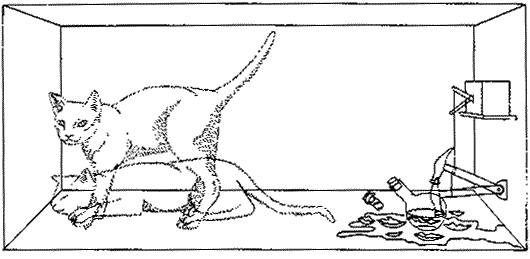
One of the very cool things that the His Dark Materials trilogy can do is really open up your imagination. The multiple worlds theory is one of the more interesting and applicable ideas in fantasy, spawning new ways to look at your favorite worlds. Anyone hear of the Schrödinger's cat paradox? The paradox states that every event is a branch point; for example if a cat is placed in a box for a day and dies, that only means it is dead in our universe. The cat is both alive and dead, even before the box is opened, but the "alive" and "dead" cats are in different branches of the universe, both of which are equally real, but which cannot interact with each other. So I started thinking about death in fantasy and how, according to Pullman, there a several universes in the HDM trilogy.
(rhetorical question) Is death an obstacle if the multiple worlds’ theory is used fantasy?
Contrary to the literature for LOTR, I believe Tolkien used this theory in Middle Earth. Gandalf fights the Bellrock and is mortally wounded doing so. He eventually dies of these wounds yet the “order” brings Gandalf back to life. The new White Wizard returns to fight for the fellowship and to destroy the ring. We all know of this, yet what realm does the order exist in and why does Gandalf feel like the years have passed by him? The simple explanation of this is that he spends time in heaven and then returns back a new man/wizard. But I’m gonna put a new twist on this idea. The White Wizard Gandalf might not be from the Middle Earth that the grey Wizard died in. On page 484 of the Two Towers in my book there is this quote:
“’Yes I am white now,’ said Gandalf... ‘But come now, tell me of yourselves! I have passed through fire and deep water, since we parted. I have forgotten much that I thought I knew, and learned again much that I had forgotten. I can see many things far off, but many things that are close at hand I cannot see. Tell me of yourselves!’”
 Now, while there are many who read into this passage, and the passage on page 491 saying that he was “sent back naked,” believing that he was sent back from heaven to complete his job. However, what is heaven in this story but another dimension, another world that is layered upon Middle Earth? (Disregarding the Silmarillion that was published in Tolkien’s name post-humorously and was never fully described by Tolkien the way he intended, and forget about Iluvatar and the stories about his creation.) Taking into account the Schrödinger's cat paradox, this “Heaven” may just be a place where Gandalf never died. The Gandalf the White present in the Two Towers conveniently cannot remember specifics to come but knows the outcome now that he is here. He had to learn about the death of Boromir and the breaking of the fellowship from Galadriel because, in his universe with him present, Boromir may have never died and the fellowship was probably together. He may have created a crack in time and space and walked through to around the time he came close to death, knowing about multiple dimensions. This is a very “what if” scenario but nonetheless it is an enlightening experience when you think about.
 Anyone else think this might be an option?
Things I generally hated about the Golden Compass movie
After reading The Golden Compass by Phillip Pullman I decided to check out the movie version despite numerous warnings from other people who had also read the book. I really liked the story and since reading and re-watching the Lord of the Rings trilogy I have learned to be a little bit easier on film adaptations. I thought that I would check it out for myself. The result was a rekindled hatred in film adaptations of books. There were so many things that I hated about this movie but before I get into those I would like to point out that the film did have two redeeming qualities; Sam Elliot as Lee Scoresby and Ian McKellen as the voice of Iorek Byrnison. That being said, two well casted roles were not enough for me to like this movie.
Let's start from the beginning. The movie opens with the voice of a narrator, I am assuming Lyra's voice, that blatantly explains that there are multiple worlds and that in "her" world people's souls reside outside their bodies in the form of daemons. As soon as this voice began to speak I should have realized how bad the film was going to be but for some reason I kept watching. I don't like this narrative voice for a couple reasons. For one, the beginning is the ONLY time that it appears in the film. I think that is just seems kind of lazy or sloppy or both. If you are going to set up a film in the context of a narrative the narrative voice should probably be consistent throughout the movie. Otherwise you don't get a sense of who the narrator is and why they are speaking or telling the story. Essentially the voice becomes a tool to throw some information at the viewer. That is really what it felt like. In Pullman's novel he begins with the story in progress and allows the reader to make inferences about the world that he sets up through sensory details, interaction between characters and interesting scenes that develop the plot as well as the world. In the film it felt as if they were shoving Pullman's world down our throats both with this opening narrative voice and awkward expository dialogue throughout.
On that note I also feel that many of the transitions and major changes throughout the film seemed incredibly forced. I'm thinking of when Serafina Pekkala literally drops in from out of nowhere and decides to introduce herself to Lyra for no apparent reason. Also the scene where Lyra and Iorek go off to find the severed child then the gyptians storm in and a battle erupts. It was like they just mashed together a bunch of parts from the book without really thinking about it too much. I just kept wondering where the Gyptians came from and how they got there so fast. Quite possibly the worst transition in this movie and probably the worst transition I have seen in ANY movie was the shift from Svalbard to Bolvangar. After the battle is over Iorek just says, "And now, I will take you to Bolvangar" and immediately there is a cut to her riding him across a snow covered field. I actually had to rewind that part and watch it again because it was so unbelievably bad. In general all of these forced transitions and moments in the film made me feel as if I were being beaten over the head with the plot of Pullman's novel.
There is also the matter of one of the most fundamental changes to the plot in the film adaptation. They completely switched the events of Svalbard and Bolvangar for the sole purpose of hyping up the battle scene at the end. I felt that this switch really took away from the complexity of the events at Svalbard. In the film we didn't get any sense that Iofur Raknison (renamed Lord Rakna in the film, presumably because it sounds cooler) is trying to go against his bear nature and act more human. Moreover, we don't see that the struggle between Iorek and Iofur is really about the conflict between two ideologies that will ultimately determine the fate of the bear race. They might as well have cut the entire sequence from the movie altogether. I also found the actual battle scene between the bears pretty tame and disappointing. When Iorek knocks off the other bear's jaw I was really hoping to see his tongue flop out like it describes in the book...then Iorek doesn't even eat his heart! It seems like they tried to downplay some of the more gruesome elements of the story in an effort to make the movie appeal to a younger audience. I found this disappointing because one of the things I liked about Pullman was that he did not seem to censor or restrict himself despite the fact that he wrote for a younger audience.
Related to the issues of censorship and restriction is the ending of the movie...Lyra and Roger fly off into the sunset in Scoresby's balloon. Credits. It seems like in an effort to make the end more appealing to younger audiences they really limited the possibility of a sequel. So how does the Subtle Knife movie start? They land the balloon, Lord Asriel brutally murders Roger in an effort to tear open the fabric of reality and thousands of kids expecting another delightful romp featuring talking bears run from the movie theater screaming and crying. I don't see it happening. If they are going adapt the whole trilogy it seems like it would almost make more sense to start again by remaking The Golden Compass with the whole project in mind. I can only hope that happens because the movie version I saw butchered a story that I really liked. It would be nice to see a version come out that actually does it justice.
Let's start from the beginning. The movie opens with the voice of a narrator, I am assuming Lyra's voice, that blatantly explains that there are multiple worlds and that in "her" world people's souls reside outside their bodies in the form of daemons. As soon as this voice began to speak I should have realized how bad the film was going to be but for some reason I kept watching. I don't like this narrative voice for a couple reasons. For one, the beginning is the ONLY time that it appears in the film. I think that is just seems kind of lazy or sloppy or both. If you are going to set up a film in the context of a narrative the narrative voice should probably be consistent throughout the movie. Otherwise you don't get a sense of who the narrator is and why they are speaking or telling the story. Essentially the voice becomes a tool to throw some information at the viewer. That is really what it felt like. In Pullman's novel he begins with the story in progress and allows the reader to make inferences about the world that he sets up through sensory details, interaction between characters and interesting scenes that develop the plot as well as the world. In the film it felt as if they were shoving Pullman's world down our throats both with this opening narrative voice and awkward expository dialogue throughout.
On that note I also feel that many of the transitions and major changes throughout the film seemed incredibly forced. I'm thinking of when Serafina Pekkala literally drops in from out of nowhere and decides to introduce herself to Lyra for no apparent reason. Also the scene where Lyra and Iorek go off to find the severed child then the gyptians storm in and a battle erupts. It was like they just mashed together a bunch of parts from the book without really thinking about it too much. I just kept wondering where the Gyptians came from and how they got there so fast. Quite possibly the worst transition in this movie and probably the worst transition I have seen in ANY movie was the shift from Svalbard to Bolvangar. After the battle is over Iorek just says, "And now, I will take you to Bolvangar" and immediately there is a cut to her riding him across a snow covered field. I actually had to rewind that part and watch it again because it was so unbelievably bad. In general all of these forced transitions and moments in the film made me feel as if I were being beaten over the head with the plot of Pullman's novel.
There is also the matter of one of the most fundamental changes to the plot in the film adaptation. They completely switched the events of Svalbard and Bolvangar for the sole purpose of hyping up the battle scene at the end. I felt that this switch really took away from the complexity of the events at Svalbard. In the film we didn't get any sense that Iofur Raknison (renamed Lord Rakna in the film, presumably because it sounds cooler) is trying to go against his bear nature and act more human. Moreover, we don't see that the struggle between Iorek and Iofur is really about the conflict between two ideologies that will ultimately determine the fate of the bear race. They might as well have cut the entire sequence from the movie altogether. I also found the actual battle scene between the bears pretty tame and disappointing. When Iorek knocks off the other bear's jaw I was really hoping to see his tongue flop out like it describes in the book...then Iorek doesn't even eat his heart! It seems like they tried to downplay some of the more gruesome elements of the story in an effort to make the movie appeal to a younger audience. I found this disappointing because one of the things I liked about Pullman was that he did not seem to censor or restrict himself despite the fact that he wrote for a younger audience.
Related to the issues of censorship and restriction is the ending of the movie...Lyra and Roger fly off into the sunset in Scoresby's balloon. Credits. It seems like in an effort to make the end more appealing to younger audiences they really limited the possibility of a sequel. So how does the Subtle Knife movie start? They land the balloon, Lord Asriel brutally murders Roger in an effort to tear open the fabric of reality and thousands of kids expecting another delightful romp featuring talking bears run from the movie theater screaming and crying. I don't see it happening. If they are going adapt the whole trilogy it seems like it would almost make more sense to start again by remaking The Golden Compass with the whole project in mind. I can only hope that happens because the movie version I saw butchered a story that I really liked. It would be nice to see a version come out that actually does it justice.
Subscribe to:
Posts (Atom)