In my comparison/contrast I decided to discuss my two favorite authors of this semester Philip Pullman and J.R.R. Tolkien.
In comparison these two authors are amazing writers who put painstakingly long hours into their works and included so much detail and description, although Tolkien definitely holds the record for including the most. Both authors have the wonderful style of writing that draws the reader into the world (s) that they have created and allows the reader to become a part of the story imagining every detail that is described almost perfectly. And at any point in time when the reader is not being actively pulled into the story, the characters and story are being described in such a way that they almost become alive in the reader's world. While these authors come from two very different backgrounds, they have two very similar writing styles in that aspect.
The contrast occurs like I said in the fact that these two men come from two very different backgrounds which greatly influenced what their series were about. Tolkien came from a Christian background and those Christian beliefs can be seen through various allegories in his series such as the theme of good vs. evil, the battle between those forces, the temptations that Frodo faces, etc. Meanwhile, while Pullman's Christian influence when he was a child turned him against Christianity and led him to a strong Atheistic view as an adult. However his views that are conveyed in his series rely more on the fact that he believed that no religious or non-religious being or agency should hold a significant amount of power or dominance over other people. He had been forced as a child to attend church and follow those beliefs, thus the themes of free will and a dominant church come into his series as the main topics.
Both these authors used their backgrounds and styles of writing to develop wonderful works of literature and even though Pullman's still causes controversy today, they both can be held in high esteem in the relms of fantasy.
Showing posts with label Pullman. Show all posts
Showing posts with label Pullman. Show all posts
Friday, December 18, 2009

Pullman Post
I have to say despite all the so-called religious controversy that Philip Pullman's His Dark Materials brings about, I love the series and his writing style.
Philip Pullman has an amazing way of writing for any age range and drawing that reader into the series so that they pick a favorite character and relate to that character throughout the entire story while still maintaining favor of many of the other characters. Yes, maybe he could have paced the second and third books in the series a little bit better but I found all of the series to be an enjoyable reading experience and it's even better to listen to on audio CD. His writing style not only draws you into the story but also makes the story and characters come alive.
The series itself has wonderful aspects. I find the controversy of religion to be one of the best things about the series. Not only was I able to write my final project off of that controversy, but I also greatly enjoyed debating with the class and myself over what the real meaning of Pullman's work is. Another aspect of the series that I loved was how the main character was a girl, most often the hero is a boy and this made the story a little bit more relateable, although I still like Urek and Lee Scoresby the best. Lastly, I found the plot and journey that takes place in the story so intriguing that it became more of a choice reading than an assigned reading because I found myself getting more and more drawn into the world Pullman had created.
Once again, this series was much better than the movie because of the amount of detail and description that was included.
Pullman's series was probably my most favorite series out of the entire semester.
Philip Pullman has an amazing way of writing for any age range and drawing that reader into the series so that they pick a favorite character and relate to that character throughout the entire story while still maintaining favor of many of the other characters. Yes, maybe he could have paced the second and third books in the series a little bit better but I found all of the series to be an enjoyable reading experience and it's even better to listen to on audio CD. His writing style not only draws you into the story but also makes the story and characters come alive.
The series itself has wonderful aspects. I find the controversy of religion to be one of the best things about the series. Not only was I able to write my final project off of that controversy, but I also greatly enjoyed debating with the class and myself over what the real meaning of Pullman's work is. Another aspect of the series that I loved was how the main character was a girl, most often the hero is a boy and this made the story a little bit more relateable, although I still like Urek and Lee Scoresby the best. Lastly, I found the plot and journey that takes place in the story so intriguing that it became more of a choice reading than an assigned reading because I found myself getting more and more drawn into the world Pullman had created.
Once again, this series was much better than the movie because of the amount of detail and description that was included.
Pullman's series was probably my most favorite series out of the entire semester.
Tuesday, December 15, 2009
Pullman and Milton: A Deeper Look
So, we all know that Pullman’s His Dark Materials trilogy is inspired heavily by Milton’s Paradise Lost, but I have a feeling that most people in our class (myself included) have not read Milton’s work and probably have little to no idea what it’s about.
Out of curiosity, and possible preparation for my research paper, I’ve been looking up deeper connections between Pullman and Milton’s works, further than just “two books where god is killed”. So far, I’m finding some pretty interesting things.
Pullman once stated himself that the aim of his work was to create Paradise Lost in three parts for adolescents. The quote that begins Golden Compass is from Milton’s work and what Pullman’s series is titled after. The actual instrument, the golden compass or alethiometer, is also mentioned by Milton:
Then staid the fervid Wheeles, and in his hand
He took the golden Compasses, prepar'd
In Gods Eternal store, to circumscribe
This Universe, and all created things
In Paradise Lost, Milton proposes a unique view on the creation of the world, and Pullman builds off of his theory. Many ideas of the world’s creation include “Chaos”—a term from Ancient Greece referring to an initial state of universe, a darkness or abyss. In mythology, Chaos is the void from which everything in existence appeared. Milton asserted that Chaos did not create God, but rather that God first created Chaos from himself and then created the world from a portion of Chaos. This theory suggests that only some of Chaos was used in the making of our world, leaving enough left over to create the existence of many more worlds. Pullman may have been following Milton’s more mythological theory in his use of multiple worlds, rather than the scientific theory we discussed in class.
Pullman’s creation of daemons as a duel nature may also be a loose mimic of Milton. Milton believed that man has two opposite natures fighting within him—reason and desire. In HDM, Lyra represents desire while Pan represents reason. Milton believed that reason was the more powerful of these two natures, and thus in the end of HDM Lyra chooses reason over desire when she leaves will forever, despite having fallen in love with him.
Finally, I would like to comment on Satan within both PL and HDM. Milton represented Satan in his work as an epic hero, yet there is no concrete character ‘Satan’ in HDM. Both Lord Asriel and Mrs. Coulter could represent him—Lord Asriel is a strong ‘hero’ waging war on God, and Mrs. Coulter forces Lyra into drug induced sleep forcing her to dream, as Satan did to Eve in Milton’s tale.
The most interesting thing I found in my light research on the similarities between these two works is that Milton wrote his work intending to test readers’ faith in God. He wrote Satan as an epic hero as a ‘trap’ for his readers to fall into—he was not purposely inserting his own anti-religion opinions into his book as Pullman did, but rather trying to strengthen and make aware of religion by challenging it.
--Molly G.
Out of curiosity, and possible preparation for my research paper, I’ve been looking up deeper connections between Pullman and Milton’s works, further than just “two books where god is killed”. So far, I’m finding some pretty interesting things.
Pullman once stated himself that the aim of his work was to create Paradise Lost in three parts for adolescents. The quote that begins Golden Compass is from Milton’s work and what Pullman’s series is titled after. The actual instrument, the golden compass or alethiometer, is also mentioned by Milton:
Then staid the fervid Wheeles, and in his hand
He took the golden Compasses, prepar'd
In Gods Eternal store, to circumscribe
This Universe, and all created things
In Paradise Lost, Milton proposes a unique view on the creation of the world, and Pullman builds off of his theory. Many ideas of the world’s creation include “Chaos”—a term from Ancient Greece referring to an initial state of universe, a darkness or abyss. In mythology, Chaos is the void from which everything in existence appeared. Milton asserted that Chaos did not create God, but rather that God first created Chaos from himself and then created the world from a portion of Chaos. This theory suggests that only some of Chaos was used in the making of our world, leaving enough left over to create the existence of many more worlds. Pullman may have been following Milton’s more mythological theory in his use of multiple worlds, rather than the scientific theory we discussed in class.
Pullman’s creation of daemons as a duel nature may also be a loose mimic of Milton. Milton believed that man has two opposite natures fighting within him—reason and desire. In HDM, Lyra represents desire while Pan represents reason. Milton believed that reason was the more powerful of these two natures, and thus in the end of HDM Lyra chooses reason over desire when she leaves will forever, despite having fallen in love with him.
Finally, I would like to comment on Satan within both PL and HDM. Milton represented Satan in his work as an epic hero, yet there is no concrete character ‘Satan’ in HDM. Both Lord Asriel and Mrs. Coulter could represent him—Lord Asriel is a strong ‘hero’ waging war on God, and Mrs. Coulter forces Lyra into drug induced sleep forcing her to dream, as Satan did to Eve in Milton’s tale.
The most interesting thing I found in my light research on the similarities between these two works is that Milton wrote his work intending to test readers’ faith in God. He wrote Satan as an epic hero as a ‘trap’ for his readers to fall into—he was not purposely inserting his own anti-religion opinions into his book as Pullman did, but rather trying to strengthen and make aware of religion by challenging it.
--Molly G.
Monday, December 14, 2009
Comparitive Post: Fantasy's progress as shown in our class
Thinking back on the three trilogies we have studied in class this semester, I’m really glad that each one is from a completely different time period. I would like to look at them comparatively in terms of time, and how these three trilogies may exemplify a genre that is rapidly changing and growing.
When we first started LOTR, we all mostly agreed that Tolkien certainly is a major writer, and also the “father of fantasy”. He was the first author to successfully create a world separate from our own, yet still very complete—introducing new races, languages, and settings that we had never known before.
Most of us agreed that Donaldson’s trilogy mimicked Tolkien’s in many ways. Both introduced new worlds with similar species, a quest involving a ring, an unlikely hero, etc. At the same time, though it didn’t always go over so well, Donaldson made changes and took risks that didn’t exist in Tolkien’s world. For one, Donaldson did not only introduce a new world, but he also included our own and made his protagonist a man from our world. He put an interesting twist on it by also making his character a leper—therefore sparking the reader’s sympathy and interest for Covenant. The biggest advancement Donaldson made within the genre though, at least between these three books, lies in the risky choices made with his main character, Thomas Covenant. Covenant is perhaps the most atypical hero, weakened and sickly from the start. Covenant is also purposely written not just to be an unlikely hero, but also to be completely unliked by readers. Donaldson took the biggest risk in actually having Covenant rape a young girl in the very beginning of his first book—something I don’t think was ever done in fantasy before and especially not before Donaldson’s time.
Finally, I think ‘His Dark Materials’ most fully exemplifies the advances happening in the ever-growing fantasy genre. Unlike the first two series, Pullman’s protagonist is a female, yet still a strong, witty, and convincing lead character. Then, in his second book, Pullman introduces another protagonist quite successfully, something not usually pulled off or even attempted in literature. Pullman’s idea of multiple worlds coincides with a true scientific theory of today, and his mixture of both magic and science supports the idea that the line between science fiction and fantasy is now blurring. Not only this, but Pullman makes religion a major theme of his work, inserting religious opinion in his books blatantly when before religious intent was merely hinted at.
It certainly is interesting to have taken this class in a time where fantasy is still a young and rapidly growing genre, to see firsthand the changes and advances being made through time from author to author.
--Molly G.
When we first started LOTR, we all mostly agreed that Tolkien certainly is a major writer, and also the “father of fantasy”. He was the first author to successfully create a world separate from our own, yet still very complete—introducing new races, languages, and settings that we had never known before.
Most of us agreed that Donaldson’s trilogy mimicked Tolkien’s in many ways. Both introduced new worlds with similar species, a quest involving a ring, an unlikely hero, etc. At the same time, though it didn’t always go over so well, Donaldson made changes and took risks that didn’t exist in Tolkien’s world. For one, Donaldson did not only introduce a new world, but he also included our own and made his protagonist a man from our world. He put an interesting twist on it by also making his character a leper—therefore sparking the reader’s sympathy and interest for Covenant. The biggest advancement Donaldson made within the genre though, at least between these three books, lies in the risky choices made with his main character, Thomas Covenant. Covenant is perhaps the most atypical hero, weakened and sickly from the start. Covenant is also purposely written not just to be an unlikely hero, but also to be completely unliked by readers. Donaldson took the biggest risk in actually having Covenant rape a young girl in the very beginning of his first book—something I don’t think was ever done in fantasy before and especially not before Donaldson’s time.
Finally, I think ‘His Dark Materials’ most fully exemplifies the advances happening in the ever-growing fantasy genre. Unlike the first two series, Pullman’s protagonist is a female, yet still a strong, witty, and convincing lead character. Then, in his second book, Pullman introduces another protagonist quite successfully, something not usually pulled off or even attempted in literature. Pullman’s idea of multiple worlds coincides with a true scientific theory of today, and his mixture of both magic and science supports the idea that the line between science fiction and fantasy is now blurring. Not only this, but Pullman makes religion a major theme of his work, inserting religious opinion in his books blatantly when before religious intent was merely hinted at.
It certainly is interesting to have taken this class in a time where fantasy is still a young and rapidly growing genre, to see firsthand the changes and advances being made through time from author to author.
--Molly G.
Wednesday, December 2, 2009
The Grandfather and the Antireligionist
All this semester we have been reading fantasy series that have created characters that we wish we knew in reality; and of the three trilogies, two have done it so fantastically, so flawlessly that it leaves the readers wishing it was possible to know them. I’m speaking, of course, of Tolkien’s Lord of the Rings trilogy and Pullman Dark Materials series. (Donaldson can keep his Unbeliever).
Tolkien’s characters are in and of themselves fantastic creations worthy of the histories created for them. He goes into intense detail regarding his characters and each has a deep, rich ancestry. He writes of strong emotional conflict and the difficult decisions each much make in the battle. His most poignant and my personal favorite character, is Aragorn. The descendent of Isildur, Aragorn is the heir to the throne of Gondor, but at the beginning of the trilogy, he hides this identity and pretends to be a ranger named Strider. That Aragorn does not claim his throne because he is not yet ready. As much as the trilogy tells of Frodo’s inner steadfastness before constant temptation, it also tells of Aragorn’s transformation from ranger to king. He must grow into the king, and his own journey proves vital not only for his rightful coronation but for the very survival and growth of the kingdoms of man. He gains confidence and self-awareness through his courageous support of Frodo and the rest of the fellowship, as well as from his love of Arwen. Each character in the trilogy is a success, and I can find little to bash about them. This is as they say the benchmark for all fantasy
Pullman also does a lot of character development and writes strong emotions and difficult decisions without letting the characters wallow or ruin the pace of the story. Pullman attempts something else in characterization that's rare and rather more difficult: this book has very few true villains. Nearly all of the characters with narrative introductions that lead you to expect them to stay in the villain role end up having other redeeming or at least understandable qualities, and frequently Pullman left me rooting in surprise for what I thought was the "wrong" side. With this, he's not always successful; Mrs. Coulter, for instance, felt like she got a personality transplant between books, and if the changes in her motivations were signalled in the previous books, I certainly missed the signs. Still, I'll forgive the occasional problems when the overall effect is so unusual and intriguing. I like reading a story that starts as traditional fantasy and then makes it clear that the sides aren't anywhere near as well-defined as they first appeared.
Friday, November 27, 2009
A Ring, A Compass, and... A Cat?
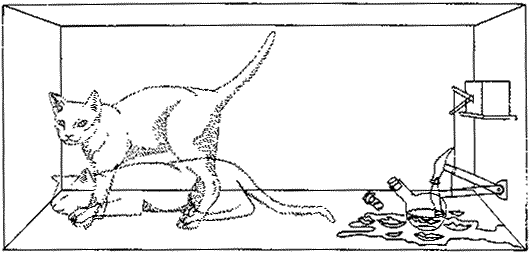
One of the very cool things that the His Dark Materials trilogy can do is really open up your imagination. The multiple worlds theory is one of the more interesting and applicable ideas in fantasy, spawning new ways to look at your favorite worlds. Anyone hear of the Schrödinger's cat paradox? The paradox states that every event is a branch point; for example if a cat is placed in a box for a day and dies, that only means it is dead in our universe. The cat is both alive and dead, even before the box is opened, but the "alive" and "dead" cats are in different branches of the universe, both of which are equally real, but which cannot interact with each other. So I started thinking about death in fantasy and how, according to Pullman, there a several universes in the HDM trilogy.
(rhetorical question) Is death an obstacle if the multiple worlds’ theory is used fantasy?
Contrary to the literature for LOTR, I believe Tolkien used this theory in Middle Earth. Gandalf fights the Bellrock and is mortally wounded doing so. He eventually dies of these wounds yet the “order” brings Gandalf back to life. The new White Wizard returns to fight for the fellowship and to destroy the ring. We all know of this, yet what realm does the order exist in and why does Gandalf feel like the years have passed by him? The simple explanation of this is that he spends time in heaven and then returns back a new man/wizard. But I’m gonna put a new twist on this idea. The White Wizard Gandalf might not be from the Middle Earth that the grey Wizard died in. On page 484 of the Two Towers in my book there is this quote:
“’Yes I am white now,’ said Gandalf... ‘But come now, tell me of yourselves! I have passed through fire and deep water, since we parted. I have forgotten much that I thought I knew, and learned again much that I had forgotten. I can see many things far off, but many things that are close at hand I cannot see. Tell me of yourselves!’”
 Now, while there are many who read into this passage, and the passage on page 491 saying that he was “sent back naked,” believing that he was sent back from heaven to complete his job. However, what is heaven in this story but another dimension, another world that is layered upon Middle Earth? (Disregarding the Silmarillion that was published in Tolkien’s name post-humorously and was never fully described by Tolkien the way he intended, and forget about Iluvatar and the stories about his creation.) Taking into account the Schrödinger's cat paradox, this “Heaven” may just be a place where Gandalf never died. The Gandalf the White present in the Two Towers conveniently cannot remember specifics to come but knows the outcome now that he is here. He had to learn about the death of Boromir and the breaking of the fellowship from Galadriel because, in his universe with him present, Boromir may have never died and the fellowship was probably together. He may have created a crack in time and space and walked through to around the time he came close to death, knowing about multiple dimensions. This is a very “what if” scenario but nonetheless it is an enlightening experience when you think about.
 Anyone else think this might be an option?
Things I generally hated about the Golden Compass movie
After reading The Golden Compass by Phillip Pullman I decided to check out the movie version despite numerous warnings from other people who had also read the book. I really liked the story and since reading and re-watching the Lord of the Rings trilogy I have learned to be a little bit easier on film adaptations. I thought that I would check it out for myself. The result was a rekindled hatred in film adaptations of books. There were so many things that I hated about this movie but before I get into those I would like to point out that the film did have two redeeming qualities; Sam Elliot as Lee Scoresby and Ian McKellen as the voice of Iorek Byrnison. That being said, two well casted roles were not enough for me to like this movie.
Let's start from the beginning. The movie opens with the voice of a narrator, I am assuming Lyra's voice, that blatantly explains that there are multiple worlds and that in "her" world people's souls reside outside their bodies in the form of daemons. As soon as this voice began to speak I should have realized how bad the film was going to be but for some reason I kept watching. I don't like this narrative voice for a couple reasons. For one, the beginning is the ONLY time that it appears in the film. I think that is just seems kind of lazy or sloppy or both. If you are going to set up a film in the context of a narrative the narrative voice should probably be consistent throughout the movie. Otherwise you don't get a sense of who the narrator is and why they are speaking or telling the story. Essentially the voice becomes a tool to throw some information at the viewer. That is really what it felt like. In Pullman's novel he begins with the story in progress and allows the reader to make inferences about the world that he sets up through sensory details, interaction between characters and interesting scenes that develop the plot as well as the world. In the film it felt as if they were shoving Pullman's world down our throats both with this opening narrative voice and awkward expository dialogue throughout.
On that note I also feel that many of the transitions and major changes throughout the film seemed incredibly forced. I'm thinking of when Serafina Pekkala literally drops in from out of nowhere and decides to introduce herself to Lyra for no apparent reason. Also the scene where Lyra and Iorek go off to find the severed child then the gyptians storm in and a battle erupts. It was like they just mashed together a bunch of parts from the book without really thinking about it too much. I just kept wondering where the Gyptians came from and how they got there so fast. Quite possibly the worst transition in this movie and probably the worst transition I have seen in ANY movie was the shift from Svalbard to Bolvangar. After the battle is over Iorek just says, "And now, I will take you to Bolvangar" and immediately there is a cut to her riding him across a snow covered field. I actually had to rewind that part and watch it again because it was so unbelievably bad. In general all of these forced transitions and moments in the film made me feel as if I were being beaten over the head with the plot of Pullman's novel.
There is also the matter of one of the most fundamental changes to the plot in the film adaptation. They completely switched the events of Svalbard and Bolvangar for the sole purpose of hyping up the battle scene at the end. I felt that this switch really took away from the complexity of the events at Svalbard. In the film we didn't get any sense that Iofur Raknison (renamed Lord Rakna in the film, presumably because it sounds cooler) is trying to go against his bear nature and act more human. Moreover, we don't see that the struggle between Iorek and Iofur is really about the conflict between two ideologies that will ultimately determine the fate of the bear race. They might as well have cut the entire sequence from the movie altogether. I also found the actual battle scene between the bears pretty tame and disappointing. When Iorek knocks off the other bear's jaw I was really hoping to see his tongue flop out like it describes in the book...then Iorek doesn't even eat his heart! It seems like they tried to downplay some of the more gruesome elements of the story in an effort to make the movie appeal to a younger audience. I found this disappointing because one of the things I liked about Pullman was that he did not seem to censor or restrict himself despite the fact that he wrote for a younger audience.
Related to the issues of censorship and restriction is the ending of the movie...Lyra and Roger fly off into the sunset in Scoresby's balloon. Credits. It seems like in an effort to make the end more appealing to younger audiences they really limited the possibility of a sequel. So how does the Subtle Knife movie start? They land the balloon, Lord Asriel brutally murders Roger in an effort to tear open the fabric of reality and thousands of kids expecting another delightful romp featuring talking bears run from the movie theater screaming and crying. I don't see it happening. If they are going adapt the whole trilogy it seems like it would almost make more sense to start again by remaking The Golden Compass with the whole project in mind. I can only hope that happens because the movie version I saw butchered a story that I really liked. It would be nice to see a version come out that actually does it justice.
Let's start from the beginning. The movie opens with the voice of a narrator, I am assuming Lyra's voice, that blatantly explains that there are multiple worlds and that in "her" world people's souls reside outside their bodies in the form of daemons. As soon as this voice began to speak I should have realized how bad the film was going to be but for some reason I kept watching. I don't like this narrative voice for a couple reasons. For one, the beginning is the ONLY time that it appears in the film. I think that is just seems kind of lazy or sloppy or both. If you are going to set up a film in the context of a narrative the narrative voice should probably be consistent throughout the movie. Otherwise you don't get a sense of who the narrator is and why they are speaking or telling the story. Essentially the voice becomes a tool to throw some information at the viewer. That is really what it felt like. In Pullman's novel he begins with the story in progress and allows the reader to make inferences about the world that he sets up through sensory details, interaction between characters and interesting scenes that develop the plot as well as the world. In the film it felt as if they were shoving Pullman's world down our throats both with this opening narrative voice and awkward expository dialogue throughout.
On that note I also feel that many of the transitions and major changes throughout the film seemed incredibly forced. I'm thinking of when Serafina Pekkala literally drops in from out of nowhere and decides to introduce herself to Lyra for no apparent reason. Also the scene where Lyra and Iorek go off to find the severed child then the gyptians storm in and a battle erupts. It was like they just mashed together a bunch of parts from the book without really thinking about it too much. I just kept wondering where the Gyptians came from and how they got there so fast. Quite possibly the worst transition in this movie and probably the worst transition I have seen in ANY movie was the shift from Svalbard to Bolvangar. After the battle is over Iorek just says, "And now, I will take you to Bolvangar" and immediately there is a cut to her riding him across a snow covered field. I actually had to rewind that part and watch it again because it was so unbelievably bad. In general all of these forced transitions and moments in the film made me feel as if I were being beaten over the head with the plot of Pullman's novel.
There is also the matter of one of the most fundamental changes to the plot in the film adaptation. They completely switched the events of Svalbard and Bolvangar for the sole purpose of hyping up the battle scene at the end. I felt that this switch really took away from the complexity of the events at Svalbard. In the film we didn't get any sense that Iofur Raknison (renamed Lord Rakna in the film, presumably because it sounds cooler) is trying to go against his bear nature and act more human. Moreover, we don't see that the struggle between Iorek and Iofur is really about the conflict between two ideologies that will ultimately determine the fate of the bear race. They might as well have cut the entire sequence from the movie altogether. I also found the actual battle scene between the bears pretty tame and disappointing. When Iorek knocks off the other bear's jaw I was really hoping to see his tongue flop out like it describes in the book...then Iorek doesn't even eat his heart! It seems like they tried to downplay some of the more gruesome elements of the story in an effort to make the movie appeal to a younger audience. I found this disappointing because one of the things I liked about Pullman was that he did not seem to censor or restrict himself despite the fact that he wrote for a younger audience.
Related to the issues of censorship and restriction is the ending of the movie...Lyra and Roger fly off into the sunset in Scoresby's balloon. Credits. It seems like in an effort to make the end more appealing to younger audiences they really limited the possibility of a sequel. So how does the Subtle Knife movie start? They land the balloon, Lord Asriel brutally murders Roger in an effort to tear open the fabric of reality and thousands of kids expecting another delightful romp featuring talking bears run from the movie theater screaming and crying. I don't see it happening. If they are going adapt the whole trilogy it seems like it would almost make more sense to start again by remaking The Golden Compass with the whole project in mind. I can only hope that happens because the movie version I saw butchered a story that I really liked. It would be nice to see a version come out that actually does it justice.
Subscribe to:
Comments (Atom)