For my final project I focused on the religious controversies surrounding Pullman's His Dark Materials trilogy and the way in which those issues may fit into a long standing dialogue between radical fundamentalist Christian readers and the genre of fantasy fiction. I drew a lot from Roland Barthes' essay "The Death of the Author" to pose the argument that most of the controversies are the result of the projection of a real or perceived authorial identity, agenda or intent onto the text. The ultimate effect is the disenfranchisement of the reader and the reduction of a complex text to a singular meaning. I mostly focused on Pullman in my paper but I also brought in Tolkien briefly so I think that for a comparison of the authors in this course I can extend some of the concepts of my argument to each.
As far as Tolkien is concerned I focused primarily on how his identity as a Catholic author could cause readers to focus only on themes in the text that are consistent with Catholic ideology. To do so would be to ignore the ways that those issues are dealt with in a subtle and complex way and also to ignore the various other different kinds of ideology that may appear in the text inadvertently. One simple example is the destruction of the ring. While one interpretation could be that Frodo gives into temptation in the end because everyone is flawed and no one person could accomplish the task alone (which may be consistant with Christian or Catholic ideas). However, it is Gollum who ultimately destroys the ring, which could be read as the only way to finally defeat evil is to give into it fully and completely. I also think that Tolkien's elevation to the status of a major author or at least one of the most influential fantasy authors of all time colors the reader's perception of the text. As a reader you go into the text with the notion that it will be just about the greatest thing you've ever read because Tolkien has received so much praise and credit for his work, which may cause you to elevate the positive aspects of the text while ignoring its weaknesses.
For Pullman I obviously discussed the religious controversies surrounding the series and the projection of the atheist author identity on the text. In my research I found that a great number of conservative Christian readers centered their arguments about a supposed "atheist agenda" that Pullman had with the series. This criticism extended to and seemed in many cases to be inspired by the production of the film adaptation of the Golden Compass. I felt that the projection of this agenda essentially reduced the series to propaganda and ignored its positive elements as well as its complexities. In order to prove this I provided examples of liberal Christian reading which found evidence in the text that supports their worldview to some extent. I also provided my own interpretation of the text in which the death of the Authority is a parallel to the death of the Author and the result was the empowering of individuals in the text which represent the readers themselves. In this way I used Pullman's texts to show that there is a complex system of ideologies in every text and though Pullman may have indeed intended to subvert religion with the series, as a reader you could potentially use the text to subvert Pullman (as an author) himself.
Ok....Donaldson. I did not include a discussion of Donaldson in my paper and I can only hope that this is the last time that I have to think or talk about him. After this post I can just try to forget that my experience with his work ever happened. That being said I think that my argument does extend to his work to some degree, at least in the context of how our class read the texts. This is a major authors course so there was already a notion that the texts we read were the works of significant and competent author figures. More importantly though this is a major authors course that focuses on fantasy fiction. We read Tolkien first and used his work to develop a kind of idea of the things that major fantasy authors are supposed to do in their texts. Tolkien set the bar high and as a major fantasy author we expected a lot from Donaldson. As we all know, he didn't deliver. I think that it is also interesting to note that as the Donaldson unit went on we sort of developed our own authorial identity for Donaldson and may have projected that onto our readings of the texts. This is the identity of the incompetent author or the hack. Since it was generally established early on that Donaldson sucked, we may have read the text looking for the more negative aspects and ignoring anything that the text may or may not have been doing that was interesting or valuable.
I didn't really realize the irony of my project until writing this post. For a final paper in a major authors course I wrote about the death of the author and the ways in which the construction of the author concept is harmful. Perhaps it is a mistake to teach a major authors course as it inevitably restricts the abilities of the reader and colors interpretations of the texts. What makes an author a major author? Perhaps its irrelevant. Maybe instead we could require English majors to take a major texts class in which we all strive to become major readers.
Showing posts with label lotr. Show all posts
Showing posts with label lotr. Show all posts
Friday, December 18, 2009

Friday, November 27, 2009
A Ring, A Compass, and... A Cat?
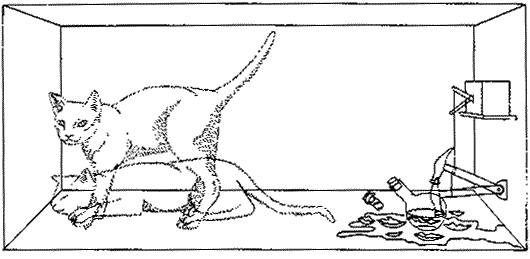
One of the very cool things that the His Dark Materials trilogy can do is really open up your imagination. The multiple worlds theory is one of the more interesting and applicable ideas in fantasy, spawning new ways to look at your favorite worlds. Anyone hear of the Schrödinger's cat paradox? The paradox states that every event is a branch point; for example if a cat is placed in a box for a day and dies, that only means it is dead in our universe. The cat is both alive and dead, even before the box is opened, but the "alive" and "dead" cats are in different branches of the universe, both of which are equally real, but which cannot interact with each other. So I started thinking about death in fantasy and how, according to Pullman, there a several universes in the HDM trilogy.
(rhetorical question) Is death an obstacle if the multiple worlds’ theory is used fantasy?
Contrary to the literature for LOTR, I believe Tolkien used this theory in Middle Earth. Gandalf fights the Bellrock and is mortally wounded doing so. He eventually dies of these wounds yet the “order” brings Gandalf back to life. The new White Wizard returns to fight for the fellowship and to destroy the ring. We all know of this, yet what realm does the order exist in and why does Gandalf feel like the years have passed by him? The simple explanation of this is that he spends time in heaven and then returns back a new man/wizard. But I’m gonna put a new twist on this idea. The White Wizard Gandalf might not be from the Middle Earth that the grey Wizard died in. On page 484 of the Two Towers in my book there is this quote:
“’Yes I am white now,’ said Gandalf... ‘But come now, tell me of yourselves! I have passed through fire and deep water, since we parted. I have forgotten much that I thought I knew, and learned again much that I had forgotten. I can see many things far off, but many things that are close at hand I cannot see. Tell me of yourselves!’”
 Now, while there are many who read into this passage, and the passage on page 491 saying that he was “sent back naked,” believing that he was sent back from heaven to complete his job. However, what is heaven in this story but another dimension, another world that is layered upon Middle Earth? (Disregarding the Silmarillion that was published in Tolkien’s name post-humorously and was never fully described by Tolkien the way he intended, and forget about Iluvatar and the stories about his creation.) Taking into account the Schrödinger's cat paradox, this “Heaven” may just be a place where Gandalf never died. The Gandalf the White present in the Two Towers conveniently cannot remember specifics to come but knows the outcome now that he is here. He had to learn about the death of Boromir and the breaking of the fellowship from Galadriel because, in his universe with him present, Boromir may have never died and the fellowship was probably together. He may have created a crack in time and space and walked through to around the time he came close to death, knowing about multiple dimensions. This is a very “what if” scenario but nonetheless it is an enlightening experience when you think about.
 Anyone else think this might be an option?
Tuesday, November 10, 2009
Tolkien and Binary Power

I have read almost all of Tolkien's work prior to the Lord of the Rings, saving his crème del la crème for a rainy day. Boy I was not disappointed! The plot may have moved slow and the dialogue/characters may have felt out of place at times, but other than that I had a very enjoyable reading experience. Maybe even too enjoyable to think critically about the text. So I took some time to look over my notes, gage the general flow of the plot one more time, and sort out the argument I have in my head regarding Tolkien.
Lets speak of the way that Tolkien portrays women, my main irk. There were a couple conversations regarding the way women are portrayed in LOTR and they are all correct in their own right. The lack of any powerful female characters, aside from Eowyn and Galadriel, is naturalizing the idea in fantasy to associate power and heroism with the masculine. Spot on interpretation, I understand that point of view. Yet the absence of female characters does not show that female power and presence is unimportant. Yes, he may be playing into conventions (Hell, at the time he was writing, he may even be creating them) that place power in a masculine role but that does not mean women are written out of the equation. When looking closely at the characters and the plot, Tolkien may in fact be doing the exact opposite of what most believe.
Tolkien's feminine characters serve as a counter to the traditional use of power, epitomized in Boramir and Faramir. Traditional power, seen in the Gondorians, is used in an effort to stifle evil in a physical way; they are characterized as brutish warriors who have a mastery over weapons and can kill Orcs, who are the epitome of evil, by the hundreds. Ultimately hubris, or pride, is tied with the traditional use of power; the more you kill the more powerful you become in the eyes of others. Pride bolsters the hero's power personally and publically, thus making the traditional use of power more associated with those characters that embody these masculine traits, which most of the time are men.

Tolkien's feminine characters critique the physical, masculine power. Instead of pride and physical combat, the feminine qualities of the characters focus on love and healing. These characters offer an alternative that can be summed up as creation over destruction. Love and health are ultimately more important than the traditional power models relied upon by Aragorn or Gandalf. Frodo can only complete his task through the constant love and companionship of Sam and the health/nourishment provided by Galadriel in the form of the Lambas bread. Remember the plot of the novels: the big four (Gandalf, Aragorn, Gimli, and Legolas) must distract Sauron so that Frodo can bring the ring to Mount Doom and destroy it. When looking at the plot this way, the masculine power model is subservient to the feminine power model.
So in the end, it may not be correct to say that Tolkien is sexist or promotes male over female. Tolkien may in fact be creating a binary power structure, one of traditional male qualities and one of female qualities. If in fact this is the case then we are left to wonder, why has fantasy seemed to use the masculine power structure more than the feminine?
Monday, October 26, 2009
There and Back Again: An Addict's Tale
The Lord of the Rings covers many various themes throughout the trilogy: brotherhood, spirituality, good vs. evil. In class we covered many of these themes and beat them to death in discussion and in-class writings. We never really touched on a theme that I found to be prominent throughout the three books: addiction. Tolkien claims to not have any sort of premeditated social comentaries inserted into the books but I don't know if I can possibly ignore the fact that the Hobbits are definitely going through problems that seem like drug addiction.
Bilbo's reaction to Gandalf's taking of the Ring and making sure it goes to Frodo is one of the most prominent parts of the series that touches on addiction. According to helpguide.org , a non-profit health website, some mental and emotional signs of addiction include "increased irritability, agitation and anger, paranoia, delusions, and lowered threshold for violence." During the scene I've chosen from The Fellowship of the Ring Bilbo seems to have many if not all of these symptoms towards Gandalf. He becomes suspicious and annoyed of Gandalf even suggesting leaving the Ring behind for Frodo to watch over.
The more the Ring is put on Frodo it seems to consume him more and more. The burden becomes heavier both mentally and physically. Gollum is a character that seems to be the user so consumed by his addiction that it is all he cares about. He killed for it and is willing to do anything for it, much like an avid drug addict.
This theme never deteriorates but is prominent even to the destruction of the Ring. Frodo journeys for three books to destroy his addiction, but in the end he seems to "relapse". He does not let go of the Ring even when he's about to finish his task and can't bear to part with it. It is only Gollum's strong lust for the Ring that destroys it.
I may be going out on a limb with this blog, but I've always felt this theme was not only prominent but also one of the stronger themes of the story. Tolkien may claim to have no premeditated themes or societal reflections but I don't know if I completely believe him.
Bilbo's reaction to Gandalf's taking of the Ring and making sure it goes to Frodo is one of the most prominent parts of the series that touches on addiction. According to helpguide.org , a non-profit health website, some mental and emotional signs of addiction include "increased irritability, agitation and anger, paranoia, delusions, and lowered threshold for violence." During the scene I've chosen from The Fellowship of the Ring Bilbo seems to have many if not all of these symptoms towards Gandalf. He becomes suspicious and annoyed of Gandalf even suggesting leaving the Ring behind for Frodo to watch over.
The more the Ring is put on Frodo it seems to consume him more and more. The burden becomes heavier both mentally and physically. Gollum is a character that seems to be the user so consumed by his addiction that it is all he cares about. He killed for it and is willing to do anything for it, much like an avid drug addict.
This theme never deteriorates but is prominent even to the destruction of the Ring. Frodo journeys for three books to destroy his addiction, but in the end he seems to "relapse". He does not let go of the Ring even when he's about to finish his task and can't bear to part with it. It is only Gollum's strong lust for the Ring that destroys it.
I may be going out on a limb with this blog, but I've always felt this theme was not only prominent but also one of the stronger themes of the story. Tolkien may claim to have no premeditated themes or societal reflections but I don't know if I completely believe him.
Tuesday, October 13, 2009
The Lord of the Rings at Radio City Music Hall
For my birthday this past weekend, my girlfriend and I went to New York City to have some fun. I figured we'd do the standard clothes shopping, pick up a fake Rolex in Battery Park, pay respects at Ground Zero, and see a show on Broadway, you know, the usual NYC experience. But my girlfriend gave me a surprise present; she bought us tickets to go see Howard Shore's score to Fellowship of the Ring performed live at Radio City Music Hall. Pretty sweet, right? Well that's not all, because the score is performed live while the film is being played on a huge movie screen behind the musicians!
This really was the ultimate performance for any Lord of the Rings fan, especially those who have a large interest in music. Maestro Ludwig Wicki lead Switzerland’s 21st Century Orchestra, the Collegiate Chorale and the Brooklyn Youth Chorus wonderfully. The kind of sound you get when you have musicians of this caliber combined with a legendary venue like Radio City Music Hall is almost indescribable. From the moment the opening note was struck until the conductor set down his baton, it was truly incredible. The mix that was used for the film was done specially for this concert. All dialogue is still intact, and the sound effects are muted slightly. This allows the music to take center stage, and boy did it.
The silences were more pregnant, the strings more playful, and the brass section, oh MAN! The brass section was absolutely ridiculous! Most of the fight scenes while the fellowship is in Moria relies on strong, thunderous trumpets, trombones, and percussion to really get your blood pumping; I don't think I've ever been so psyched up because of music in my life. I swear I could feel the Orcs nipping at my heels and sense the heat from the Balrog!
It is unfortunate that this was only a one weekend event, because I would love for more people to be able to experience this film as we were able to this past weekend. However, when the credits finished rolling and the screen went black, the audience was greeted with this advertisement: "Howard Shore's score for The Two Towers, performed live October 10th and 11th, at Radio City Music Hall. Come join us next year and continue the journey!" So if this is something you'd be interested in, keep an eye out for when tickets go on sale! I think I know what one of my birthday presents will be next year.
More information:
The Official Lord of the Rings Concert Website
The view from our seats (slightly zoomed in):

The marquee:

-Andrew Garvey
This really was the ultimate performance for any Lord of the Rings fan, especially those who have a large interest in music. Maestro Ludwig Wicki lead Switzerland’s 21st Century Orchestra, the Collegiate Chorale and the Brooklyn Youth Chorus wonderfully. The kind of sound you get when you have musicians of this caliber combined with a legendary venue like Radio City Music Hall is almost indescribable. From the moment the opening note was struck until the conductor set down his baton, it was truly incredible. The mix that was used for the film was done specially for this concert. All dialogue is still intact, and the sound effects are muted slightly. This allows the music to take center stage, and boy did it.
The silences were more pregnant, the strings more playful, and the brass section, oh MAN! The brass section was absolutely ridiculous! Most of the fight scenes while the fellowship is in Moria relies on strong, thunderous trumpets, trombones, and percussion to really get your blood pumping; I don't think I've ever been so psyched up because of music in my life. I swear I could feel the Orcs nipping at my heels and sense the heat from the Balrog!
It is unfortunate that this was only a one weekend event, because I would love for more people to be able to experience this film as we were able to this past weekend. However, when the credits finished rolling and the screen went black, the audience was greeted with this advertisement: "Howard Shore's score for The Two Towers, performed live October 10th and 11th, at Radio City Music Hall. Come join us next year and continue the journey!" So if this is something you'd be interested in, keep an eye out for when tickets go on sale! I think I know what one of my birthday presents will be next year.
More information:
The Official Lord of the Rings Concert Website
The view from our seats (slightly zoomed in):
The marquee:
-Andrew Garvey
Subscribe to:
Posts (Atom)