In my comparison/contrast I decided to discuss my two favorite authors of this semester Philip Pullman and J.R.R. Tolkien.
In comparison these two authors are amazing writers who put painstakingly long hours into their works and included so much detail and description, although Tolkien definitely holds the record for including the most. Both authors have the wonderful style of writing that draws the reader into the world (s) that they have created and allows the reader to become a part of the story imagining every detail that is described almost perfectly. And at any point in time when the reader is not being actively pulled into the story, the characters and story are being described in such a way that they almost become alive in the reader's world. While these authors come from two very different backgrounds, they have two very similar writing styles in that aspect.
The contrast occurs like I said in the fact that these two men come from two very different backgrounds which greatly influenced what their series were about. Tolkien came from a Christian background and those Christian beliefs can be seen through various allegories in his series such as the theme of good vs. evil, the battle between those forces, the temptations that Frodo faces, etc. Meanwhile, while Pullman's Christian influence when he was a child turned him against Christianity and led him to a strong Atheistic view as an adult. However his views that are conveyed in his series rely more on the fact that he believed that no religious or non-religious being or agency should hold a significant amount of power or dominance over other people. He had been forced as a child to attend church and follow those beliefs, thus the themes of free will and a dominant church come into his series as the main topics.
Both these authors used their backgrounds and styles of writing to develop wonderful works of literature and even though Pullman's still causes controversy today, they both can be held in high esteem in the relms of fantasy.
Showing posts with label tolkien. Show all posts
Showing posts with label tolkien. Show all posts
Friday, December 18, 2009

Tolkien Post
When I began the semester in English 427, I had never really read any fantasy before and never read any of the works of these authors that we studied. I had attempted to read The Lord of the Rings Trilogy back in high school but didn't get past chapter 4 in the first book. Sure I had seen the movies and even seen Golden Compass, but I didn't really have any idea of what I was getting myself into.
As we began reading J.R.R. Tolkien's series and discussing it in class, I really began to realize what fantasy was all about and how much detail goes into these works. Tolkien put such painstaking effort into his writings that they often didn't get published for many years at a time. Although his writing style could be very overwhelming at times because of all the details he put in and how long it took to get through the books, I really did enjoy reading his series and found the books much better than the movies in many ways.
While the action in the movies is highly intense and visual is sometimes better than what your imagination can give, the books have much more detail and description to offer along with the many more characters that are included. The movies tend to leave out certain details and aspects that play key roles to the plot of the story. For instance that whole section about the ents and the entwives is basically left out of the movie. The ents are included but they barely touch on the history of what occurred and what happens. Another example is when Frodo is running to get to Rivendale before the Dark Kings catch him, he is saved by a guy elf (I can't remember his name right now) who is completely left out of the movie.
Tolkien did a fantastic job of writing with such detail and description that he draws the reader in and allows the reader to use their imagination to picture almost every detail as if he were right there with his favorite character. He also presents the battle of good vs. evil and many other challenging conflicts that humans must face in life. While he doesn't necessarily give the answers to these conflicts, he does give interesting ideas as to how to solve them or find ways to deal with them. His series definitely was a great selection to start out the semester since I wasn't a fan of fantasy and he made me at least a little bit more interested in fantasy and a lot more knowledgeable about how much better the books are from the movies.
As we began reading J.R.R. Tolkien's series and discussing it in class, I really began to realize what fantasy was all about and how much detail goes into these works. Tolkien put such painstaking effort into his writings that they often didn't get published for many years at a time. Although his writing style could be very overwhelming at times because of all the details he put in and how long it took to get through the books, I really did enjoy reading his series and found the books much better than the movies in many ways.
While the action in the movies is highly intense and visual is sometimes better than what your imagination can give, the books have much more detail and description to offer along with the many more characters that are included. The movies tend to leave out certain details and aspects that play key roles to the plot of the story. For instance that whole section about the ents and the entwives is basically left out of the movie. The ents are included but they barely touch on the history of what occurred and what happens. Another example is when Frodo is running to get to Rivendale before the Dark Kings catch him, he is saved by a guy elf (I can't remember his name right now) who is completely left out of the movie.
Tolkien did a fantastic job of writing with such detail and description that he draws the reader in and allows the reader to use their imagination to picture almost every detail as if he were right there with his favorite character. He also presents the battle of good vs. evil and many other challenging conflicts that humans must face in life. While he doesn't necessarily give the answers to these conflicts, he does give interesting ideas as to how to solve them or find ways to deal with them. His series definitely was a great selection to start out the semester since I wasn't a fan of fantasy and he made me at least a little bit more interested in fantasy and a lot more knowledgeable about how much better the books are from the movies.
Monday, December 14, 2009
Comparitive Post: Fantasy's progress as shown in our class
Thinking back on the three trilogies we have studied in class this semester, I’m really glad that each one is from a completely different time period. I would like to look at them comparatively in terms of time, and how these three trilogies may exemplify a genre that is rapidly changing and growing.
When we first started LOTR, we all mostly agreed that Tolkien certainly is a major writer, and also the “father of fantasy”. He was the first author to successfully create a world separate from our own, yet still very complete—introducing new races, languages, and settings that we had never known before.
Most of us agreed that Donaldson’s trilogy mimicked Tolkien’s in many ways. Both introduced new worlds with similar species, a quest involving a ring, an unlikely hero, etc. At the same time, though it didn’t always go over so well, Donaldson made changes and took risks that didn’t exist in Tolkien’s world. For one, Donaldson did not only introduce a new world, but he also included our own and made his protagonist a man from our world. He put an interesting twist on it by also making his character a leper—therefore sparking the reader’s sympathy and interest for Covenant. The biggest advancement Donaldson made within the genre though, at least between these three books, lies in the risky choices made with his main character, Thomas Covenant. Covenant is perhaps the most atypical hero, weakened and sickly from the start. Covenant is also purposely written not just to be an unlikely hero, but also to be completely unliked by readers. Donaldson took the biggest risk in actually having Covenant rape a young girl in the very beginning of his first book—something I don’t think was ever done in fantasy before and especially not before Donaldson’s time.
Finally, I think ‘His Dark Materials’ most fully exemplifies the advances happening in the ever-growing fantasy genre. Unlike the first two series, Pullman’s protagonist is a female, yet still a strong, witty, and convincing lead character. Then, in his second book, Pullman introduces another protagonist quite successfully, something not usually pulled off or even attempted in literature. Pullman’s idea of multiple worlds coincides with a true scientific theory of today, and his mixture of both magic and science supports the idea that the line between science fiction and fantasy is now blurring. Not only this, but Pullman makes religion a major theme of his work, inserting religious opinion in his books blatantly when before religious intent was merely hinted at.
It certainly is interesting to have taken this class in a time where fantasy is still a young and rapidly growing genre, to see firsthand the changes and advances being made through time from author to author.
--Molly G.
When we first started LOTR, we all mostly agreed that Tolkien certainly is a major writer, and also the “father of fantasy”. He was the first author to successfully create a world separate from our own, yet still very complete—introducing new races, languages, and settings that we had never known before.
Most of us agreed that Donaldson’s trilogy mimicked Tolkien’s in many ways. Both introduced new worlds with similar species, a quest involving a ring, an unlikely hero, etc. At the same time, though it didn’t always go over so well, Donaldson made changes and took risks that didn’t exist in Tolkien’s world. For one, Donaldson did not only introduce a new world, but he also included our own and made his protagonist a man from our world. He put an interesting twist on it by also making his character a leper—therefore sparking the reader’s sympathy and interest for Covenant. The biggest advancement Donaldson made within the genre though, at least between these three books, lies in the risky choices made with his main character, Thomas Covenant. Covenant is perhaps the most atypical hero, weakened and sickly from the start. Covenant is also purposely written not just to be an unlikely hero, but also to be completely unliked by readers. Donaldson took the biggest risk in actually having Covenant rape a young girl in the very beginning of his first book—something I don’t think was ever done in fantasy before and especially not before Donaldson’s time.
Finally, I think ‘His Dark Materials’ most fully exemplifies the advances happening in the ever-growing fantasy genre. Unlike the first two series, Pullman’s protagonist is a female, yet still a strong, witty, and convincing lead character. Then, in his second book, Pullman introduces another protagonist quite successfully, something not usually pulled off or even attempted in literature. Pullman’s idea of multiple worlds coincides with a true scientific theory of today, and his mixture of both magic and science supports the idea that the line between science fiction and fantasy is now blurring. Not only this, but Pullman makes religion a major theme of his work, inserting religious opinion in his books blatantly when before religious intent was merely hinted at.
It certainly is interesting to have taken this class in a time where fantasy is still a young and rapidly growing genre, to see firsthand the changes and advances being made through time from author to author.
--Molly G.
Saturday, December 12, 2009
Looking at Tolkien v.s. Donaldson (liar, liar pants on fire)

“Ah, where to begin? Let me say first that I shudder every
time anybody compares / contrasts COVENANT with LORD OF THE RINGS.”
-Stephen R. Donaldson

Let the shuddering begin Mr. Donaldson, let it begin. Despite saying that the Thomas Covenant series is all his own creation there are a lot of similarities to J.R.R. Tolkien’s adventure of a hobbit and a ring in his Lord of the Ring trilogy.
Let’s start with the most obvious, the ring of course. Both books center on a character having a golden ring. Frodo is put in charge of destroying the ring where Covenant must learn to control the ring.
Both Covenant and Frodo seemed like unlikely heroes to me. Perhaps I was biased against Covenant but I was hard pressed to see a rapist as a hero. He was also uncaring about the Land and pretty self-centered for the majority of the first book. He was obviously supposed to be the hero though. To the people of the Land, Covenant was the second coming of Berek Halfhand and he had the ring of white gold. Frodo was perhaps not the obvious hero like Aragorn but I still count him as a hero. He bore and destroyed the ring despite being a small hobbit in a very big world with a very big evil. Frodo cares about Middle Earth more than Covenant could ever care about the people in the Land. With both Covenant and Frodo the other characters in the books supported them and made sure their missions were possible to be carried out.
The peoples in both books are very similar. The people of Mithil Stonedown could easily be compared to the dwarves of Middle Earth. Both work with stone. The people of Soaring Woodhelven could be compared to the elves. They are both very connected with nature especially trees. Their physical features are similar to elves as well, being fair and tall. The Ramen could be compared to the Rohan. Both are races of men connected to horses, although the Ramen’s connection to the Ranyhyn is deeper than the peoples of Middle Earth to their horses.
Covenant and Frodo are not leaders of great armies so there must be someone to lead the army of good against evil. Hile Troy and Aragorn can be seen as the battle leading heroes. These are the men that we think of when we picture those great leaders gathering their army to trudge off to battle against evil doers. Also the Troy and Aragorn always seem to be split from Covenant and Frodo. They lead the big battles while in another part of the world Covenant and Frodo are completing quieter missions.
Tolkien I felt was the better writer. Yes, parts of the trilogy are slow and sometimes there is almost too much description. I don’t mind that though because I would rather have that description that slows me down than the description of the Land we were given. I wanted to know more what the people of the Land looked like and how the Land looked. I was more connected with Tolkien’s characters because they reminded me of the noble character of Arthurian legends. Often I didn’t care about or for the characters in the Covenant series. I wasn’t pushing for Covenant to win. I would’ve been fine if Triock killed Covenant in the eighth chapter. Elena’s affection for Covenant, her father, was creepy quite honestly.
So Mr. Donaldson I have to disagree with you that LOTR did not have anything to do with Thomas Covenant. It obviously influenced your writing but I’m done comparing you for now so just calm down, the shudders will stop soon.
Thursday, December 10, 2009
Tolkien
As we finish up the last book in the course I’ve been looking back at the other trilogies we’ve read, and after reading Donaldson and Pullman, I feel like a little light has been shed on J.R.R. Tolkien. I first read the Lord of the Rings trilogy when I was around 12 or 13, and I have to say I was somewhat underwhelmed with the story. I remember having a problem with the pacing of the books and how long it took to get through certain passages. It just seemed that the style that Tolkien was writing in was too droll and boring. Of course this was back when I was a kid, and my views on Tolkien have changed drastically since then.
When reading the trilogy the second time around, I started to appreciate not only the story more, but the way that it’s written. This time around I started to pay more attention to the lush details that Tolkien fills the pages with, which at times was almost intoxicating. He has such a command over his style that he can seemingly pull these incredible descriptions out of nowhere. The world that he creates is so massive yet so complete in its history and evolution, with each race and civilization having their own language and culture, as if they had been around this whole time. This goes with the idea that Tolkien wanted to create a mythical representation for Britain. Creatures seem familiar yet strange and new at the same time.
One of the things that I noticed after reading the other two trilogies was how Tolkien handles his characters differently than Donaldson and Pullman. Since the world he created is so large, it almost feels like his characters feel much smaller and insignificant compared to the scale of Middle Earth. This sort of lessens the impact of the story, which in itself is amazingly written. There seems to be a greater distance between the narrator and the characters, as if the narrator cares more about details and descriptions than getting inside the character’s head. That’s not to say there isn’t any emotional connection or character development, the many different personalities are rewarding on their own, but it’s more that there is a greater focus on the big picture. It operates on such a large scale that naturally some characters are going to get sacrificed for additional descriptions and details about the bigger story, which revolves around Sauron and his dark power.
These are just a few things that I noticed after finishing all of the trilogies for the class. The Lord of the Rings is still a fantastic series which I can appreciate more after reading it a second time as well as comparing it to other works of fantasy. Tolkien himself is a master at what he does and should no doubt be considered a major author, seeing as how this series influenced so many other books that came after.
Gollum: Character Analysis
Many times over the course of this semester, we have discussed that one of fantasy’s major problems is that it almost always puts good and evil in black-and-white terms. To me, this is especially apparent in Lord of the Rings. Almost every character within the trilogy is either wholly good or wholly evil, at least in the way Tolkien presents them to the reader.
The one character that is the exception to the rule is Gollum/Smeagol. He is a representation of the dichotomy of good and evil encompassed in one character. Smeagol is made relatable and pitiable because Tolkien gives his readers a glimpse into his past (something he doesn’t even do with some of his larger characters, like Gandalf). We learn that Smeagol was once a creature very much like a hobbit, who lived almost exactly as Frodo and the others did. His struggle over the Ring, his torture and suffering because of it, are revealed to the reader in both the trilogy and its prequel, The Hobbit. We are able to see his transition both physically and mentally from Smeagol into the creature Gollum, who is seen as someone completely corrupted and warped by the Ring’s power. Yet, at the same time, parts of Smeagol still exist within him and are shown to the reader as if the creature has some sort of multiple personality disorder. To me, this makes Gollum one of the most dimensional characters of the entire story.
Gollum is so important as a character because I believe he represents the potential of every other character in the story, and also the potential of the Ring. He is the biggest embodiment of the Ring’s power, showing how it warped him physically into a disgusting creature, unnaturally prolonged his life, and drove him mentally insane to the point of death, following the Ring into its fiery demise. He is the example of what Frodo could become, and an example of what every person destroyed by the Ring’s power once was.
It is interesting to me that Tolkien decided to handle good and evil in this way. Instead of making it apparent in every character, he used one specific character as a representation of the push and pull of it within each of us. In a way, the dimensions of Gollum/Smeagol make every other character seem deeper and more layered as well. Because of this, we are able to love the ‘good’ characters while still understanding the potential weakness and darkness within them.
-Molly G.
Wednesday, December 9, 2009
Tolkien and Pullman: Major Authors of the Anti-Climax
Stories are always written to have an ending no matter how long it takes to get there, whether it be a trilogy or a massive series. No matter how long the narrative the reader is always waiting for that ultimate climax and is reading to have closure at some point. As a comparative blog for Major Authors, I'd like to compare the endings to the two trilogies from the (in my opinion) two major authors in this class: J.R.R. Tolkien's The Lord of the Rings and Philip Pullman's His Dark Materials. Both of these trilogies seem to end on an seemingly anti-climax that should have ended a chapter or two earlier.
The last couple chapters in The Return of the King revolve around the Hobbits saying their goodbyes to their multi-racial friends and heading back to the Shire. As they return to the Shire we get an extended chapter that feels more like a short story as an afterthought to make the final book longer than it should have been. The Hobbits are forced to get the remainder of Sauraman's henchmen out of their land so that the Shire can be rebuilt back to their comfort zone. This isn't necessarily a bad chapter, but it takes away from the finality of the destruction of the Ring and the restoration of Middle-Earth. It seems as though Tolkien couldn't stand the thought of a short (compared to the previous two novels) final book and needed to tack on a light-hearted ending that forces the reader to return to the Shire one last time.
As I've stated in the discussion forum, I believe this final chapter seems to be more of a companion piece that could have been a separate short story released after the trilogy was published. It does not seem to serve a purpose other than to drag the reader through an anti-climatic ending when we have already had at least two different endings that suffice to end the trilogy on a high and optimistic note. We get closure when the Hobbits leave Rivendell and we also get it when the other main characters say farewell. The Shire saving chapter is nice and it fits with the world, but not the tone of the rest of the novel.
The Amber Spyglass could have done without a few things, namely the last ten or so pages. Mrs. Coulter and Lord Asriel have already killed the main bad guy about a hundred pages or more before this ending, which really takes away any chance of an ultimate climax, but seeing Will and Mary almost forcibly become friends and roommates, along with Lyra deciding to go to boarding school was not the most epic of endings. Perhaps the best way to end it would be the closing of the window, the destruction of the knife and Lyra sitting in the garden. No dinner scene, no Will and Mary becoming chummy, but a serene and somewhat open ended ending. We don't need a clear sense of what Lyra's future or Will and Mary's future holds, because Pullman is already going to apparently do that with future sequels.
Not knowing the future of a charter or characters always lets the reader do their own imagining of it, and it is much more satisfying than an anti-climatic and force-fed ending.
The last couple chapters in The Return of the King revolve around the Hobbits saying their goodbyes to their multi-racial friends and heading back to the Shire. As they return to the Shire we get an extended chapter that feels more like a short story as an afterthought to make the final book longer than it should have been. The Hobbits are forced to get the remainder of Sauraman's henchmen out of their land so that the Shire can be rebuilt back to their comfort zone. This isn't necessarily a bad chapter, but it takes away from the finality of the destruction of the Ring and the restoration of Middle-Earth. It seems as though Tolkien couldn't stand the thought of a short (compared to the previous two novels) final book and needed to tack on a light-hearted ending that forces the reader to return to the Shire one last time.
As I've stated in the discussion forum, I believe this final chapter seems to be more of a companion piece that could have been a separate short story released after the trilogy was published. It does not seem to serve a purpose other than to drag the reader through an anti-climatic ending when we have already had at least two different endings that suffice to end the trilogy on a high and optimistic note. We get closure when the Hobbits leave Rivendell and we also get it when the other main characters say farewell. The Shire saving chapter is nice and it fits with the world, but not the tone of the rest of the novel.
The Amber Spyglass could have done without a few things, namely the last ten or so pages. Mrs. Coulter and Lord Asriel have already killed the main bad guy about a hundred pages or more before this ending, which really takes away any chance of an ultimate climax, but seeing Will and Mary almost forcibly become friends and roommates, along with Lyra deciding to go to boarding school was not the most epic of endings. Perhaps the best way to end it would be the closing of the window, the destruction of the knife and Lyra sitting in the garden. No dinner scene, no Will and Mary becoming chummy, but a serene and somewhat open ended ending. We don't need a clear sense of what Lyra's future or Will and Mary's future holds, because Pullman is already going to apparently do that with future sequels.
Not knowing the future of a charter or characters always lets the reader do their own imagining of it, and it is much more satisfying than an anti-climatic and force-fed ending.
Wednesday, December 2, 2009
The Grandfather and the Antireligionist
All this semester we have been reading fantasy series that have created characters that we wish we knew in reality; and of the three trilogies, two have done it so fantastically, so flawlessly that it leaves the readers wishing it was possible to know them. I’m speaking, of course, of Tolkien’s Lord of the Rings trilogy and Pullman Dark Materials series. (Donaldson can keep his Unbeliever).
Tolkien’s characters are in and of themselves fantastic creations worthy of the histories created for them. He goes into intense detail regarding his characters and each has a deep, rich ancestry. He writes of strong emotional conflict and the difficult decisions each much make in the battle. His most poignant and my personal favorite character, is Aragorn. The descendent of Isildur, Aragorn is the heir to the throne of Gondor, but at the beginning of the trilogy, he hides this identity and pretends to be a ranger named Strider. That Aragorn does not claim his throne because he is not yet ready. As much as the trilogy tells of Frodo’s inner steadfastness before constant temptation, it also tells of Aragorn’s transformation from ranger to king. He must grow into the king, and his own journey proves vital not only for his rightful coronation but for the very survival and growth of the kingdoms of man. He gains confidence and self-awareness through his courageous support of Frodo and the rest of the fellowship, as well as from his love of Arwen. Each character in the trilogy is a success, and I can find little to bash about them. This is as they say the benchmark for all fantasy
Pullman also does a lot of character development and writes strong emotions and difficult decisions without letting the characters wallow or ruin the pace of the story. Pullman attempts something else in characterization that's rare and rather more difficult: this book has very few true villains. Nearly all of the characters with narrative introductions that lead you to expect them to stay in the villain role end up having other redeeming or at least understandable qualities, and frequently Pullman left me rooting in surprise for what I thought was the "wrong" side. With this, he's not always successful; Mrs. Coulter, for instance, felt like she got a personality transplant between books, and if the changes in her motivations were signalled in the previous books, I certainly missed the signs. Still, I'll forgive the occasional problems when the overall effect is so unusual and intriguing. I like reading a story that starts as traditional fantasy and then makes it clear that the sides aren't anywhere near as well-defined as they first appeared.
Fine Wine Versus Cheap Beer

In writing the Lord of the Rings, J.R.R. Tolkien was not trying to alter a genre or create some crazy phenomenon that would eventual be known by children and parents, geeks and jocks, and everyone in between. He was only trying to create a bedtime fairy story for his children, but in writing this innocent story for his children, Tolkien did indeed create this genre changing trilogy. Not only did Tolkien create one of the best known, well written, and time tested trilogy’s, he also has become one of the most well-known authors in the fantasy world. Tolkien’s story has crossed so many media forms: literature, film, plays, and even more recently videogames.
What effects has Stephen Donaldson’s The Chronicles of Thomas Covenant the Unbeliever done? Has Donaldson changed a genre? Effected readers? Has this trilogy become a household name? How about crossing media platforms? Definitely not.
I almost feel bad for comparing these two authors and their trilogies; I feel that in doing this I am causing some sort of insult to Tolkien. I want to apologize before I go any further. With that said, let’s continue.
Comparing these two authors is not like comparing apples and oranges, but more like comparing fine wine to… ummm… Golden Anniversary maybe? Fine wine needs to be at the right temperature, let the wine breathe for a moment so that the complexities of the different flavors shine, and enjoyed slowly while being sipped; very much like Tolkien’s trilogy. Like wine, Tolkien’s fantasy story needs to be enjoyed slowly so that the “complexities of the different flavors shine”. There is so much time and attention spent on details and complexities of world building and plot structure within The Lord of the Rings that it is easily comparable to Dom. Romane Conti 1997 (which is a red burgundy wine that runs about $1,540 a bottle).
 Unlike Tolkien however, Donaldson is more like a really cheap beer; something that you would drink underage because you can’t afford anything better and also because you have no experience drinking, so you have no idea what taste is all about. Just like cheap beer, Donaldson leaves you with a headache, nausea, and the spins (not to mention what I like to call the horrible feeling of “beer-s*** syndrome”).
 Friday, November 27, 2009
A Ring, A Compass, and... A Cat?
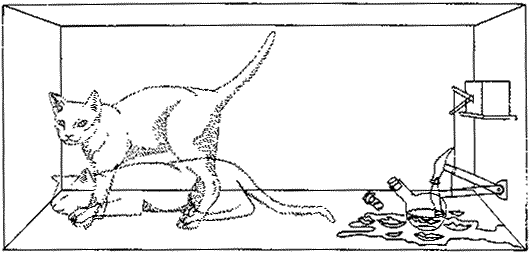
One of the very cool things that the His Dark Materials trilogy can do is really open up your imagination. The multiple worlds theory is one of the more interesting and applicable ideas in fantasy, spawning new ways to look at your favorite worlds. Anyone hear of the Schrödinger's cat paradox? The paradox states that every event is a branch point; for example if a cat is placed in a box for a day and dies, that only means it is dead in our universe. The cat is both alive and dead, even before the box is opened, but the "alive" and "dead" cats are in different branches of the universe, both of which are equally real, but which cannot interact with each other. So I started thinking about death in fantasy and how, according to Pullman, there a several universes in the HDM trilogy.
(rhetorical question) Is death an obstacle if the multiple worlds’ theory is used fantasy?
Contrary to the literature for LOTR, I believe Tolkien used this theory in Middle Earth. Gandalf fights the Bellrock and is mortally wounded doing so. He eventually dies of these wounds yet the “order” brings Gandalf back to life. The new White Wizard returns to fight for the fellowship and to destroy the ring. We all know of this, yet what realm does the order exist in and why does Gandalf feel like the years have passed by him? The simple explanation of this is that he spends time in heaven and then returns back a new man/wizard. But I’m gonna put a new twist on this idea. The White Wizard Gandalf might not be from the Middle Earth that the grey Wizard died in. On page 484 of the Two Towers in my book there is this quote:
“’Yes I am white now,’ said Gandalf... ‘But come now, tell me of yourselves! I have passed through fire and deep water, since we parted. I have forgotten much that I thought I knew, and learned again much that I had forgotten. I can see many things far off, but many things that are close at hand I cannot see. Tell me of yourselves!’”
 Now, while there are many who read into this passage, and the passage on page 491 saying that he was “sent back naked,” believing that he was sent back from heaven to complete his job. However, what is heaven in this story but another dimension, another world that is layered upon Middle Earth? (Disregarding the Silmarillion that was published in Tolkien’s name post-humorously and was never fully described by Tolkien the way he intended, and forget about Iluvatar and the stories about his creation.) Taking into account the Schrödinger's cat paradox, this “Heaven” may just be a place where Gandalf never died. The Gandalf the White present in the Two Towers conveniently cannot remember specifics to come but knows the outcome now that he is here. He had to learn about the death of Boromir and the breaking of the fellowship from Galadriel because, in his universe with him present, Boromir may have never died and the fellowship was probably together. He may have created a crack in time and space and walked through to around the time he came close to death, knowing about multiple dimensions. This is a very “what if” scenario but nonetheless it is an enlightening experience when you think about.
 Anyone else think this might be an option?
Monday, November 9, 2009
The Value of Tolkien's Lord of The Rings trilogy
Reading The Lord of The Rings trilogy has confirmed the place of Tolkien as my favorite fantasy author and as highly ranked among writers altogether. This is founded primarily upon the subject matter of his works but also includes the nearly tangible effect from his imaginative world building of Middle Earth, as well as the epic plot which is well-composed using various sub-plotlines. The story is effectively carried through the changing perspectives of multiple characters, contributing to their individual character development while further illustrating a well-rounded plot. I also enjoy Tolkien for his unique writing style. This was a matter of debate in our class, since there are those who enjoy the longer descriptions and the “slow pace” of the story at times and others who find it superfluous compared with other parts of the work. His influences from European mythology give his writing style unique character, reflecting the prose of Nordic mythology among others. Personally, I prefer his sometimes over-the-top and perhaps unnecessary emphasis on the description of surroundings and the inclusion of various historical details. It may have no concrete relation to the story itself, but it is still enjoyable to read since it is simply adding more to the world of Middle Earth.
I would also like to comment on the association of escapism with Tolkien. The entire genre of fantasy depends on escapism to some degree, as can be said with any other fiction reading; however I disagree that this association should carry a negative connotation. In my view, the stronger the power of the escapism, the more credibility is due to the work. Especially in the case of Tolkien, I do not think that the escapism in his works serves as grounds for criticism. I do not believe that Tolkien is entirely escapism, as The Lord of the Rings alludes to certain themes and ideas that are applicable to reality when reduced from its fantastical appeal. For instance, the idea of several races putting aside their feuds and disagreements, some of which have been deeply ingrained in their history, to unite for a common cause is an idea which is very significant to reality. Recognizing the greater evil puts the quarrels of the races into perspective and even contributes to the races beginning to understand each other and develop new relations. For example, Gimli, upon his visit to Lothlorien, is at first regarded with aversion and distrust, and likewise are his views of the Elves, but even by the end of his visit and continuing throughout the rest of the story, his relations with the Elves are strengthened, as can be examined through his bond with Legolas. One of Gandalf’s well-known aphorisms, “[a]ll we to decide is what to do with the time that is given to us” is also an example of a valuable idea which can be taken from the work. I do not believe that this is why The Lord of The Rings is so highly claimed, but I also think that these aspects contribute to the appeal of the work and should not be unmentioned.
Subscribe to:
Comments (Atom)