Showing posts with label lord of the rings. Show all posts

Tuesday, December 23, 2014

Fredonia's Got Talent!

My students in Fantasy Fiction and Novels and Tales did some amazing work throughout the semester, and particularly at the end.  Unfortunately, most of them chose not to do web authoring projects, so I can't share their work here.  Fortunately, a good number did; here are links to their work:
Please check 'em out while you're waiting for me to finish grading and get back to posting student essays that respond to the questions my students generated at the start of the semester!

[cross-posted at Mostly Harmless and Citizen of Somewhere Else]

Wednesday, December 23, 2009

Check It Out: Fall 2009 Student Web Projects

From ENGL 208/AMST 210: American Popular and Mass Cultures

Disney vs. Grimm
Panic at the Cinema
Video Games and Film
Viral Media Check

And don't miss Steve Bosco's post on his decision to re-score the "star gate" sequence in Stanley Kubrick's 2001.

From ENGL 427: Major Writers

Gary Aloisio on myth and Tolkien, Donaldson, and Pullman
Max Soule-Oneto on Pullman's His Dark Materials

Friday, December 18, 2009

Pullman vs. Tolkien Post

In my comparison/contrast I decided to discuss my two favorite authors of this semester Philip Pullman and J.R.R. Tolkien.
In comparison these two authors are amazing writers who put painstakingly long hours into their works and included so much detail and description, although Tolkien definitely holds the record for including the most. Both authors have the wonderful style of writing that draws the reader into the world (s) that they have created and allows the reader to become a part of the story imagining every detail that is described almost perfectly. And at any point in time when the reader is not being actively pulled into the story, the characters and story are being described in such a way that they almost become alive in the reader's world. While these authors come from two very different backgrounds, they have two very similar writing styles in that aspect.
The contrast occurs like I said in the fact that these two men come from two very different backgrounds which greatly influenced what their series were about. Tolkien came from a Christian background and those Christian beliefs can be seen through various allegories in his series such as the theme of good vs. evil, the battle between those forces, the temptations that Frodo faces, etc. Meanwhile, while Pullman's Christian influence when he was a child turned him against Christianity and led him to a strong Atheistic view as an adult. However his views that are conveyed in his series rely more on the fact that he believed that no religious or non-religious being or agency should hold a significant amount of power or dominance over other people. He had been forced as a child to attend church and follow those beliefs, thus the themes of free will and a dominant church come into his series as the main topics.
Both these authors used their backgrounds and styles of writing to develop wonderful works of literature and even though Pullman's still causes controversy today, they both can be held in high esteem in the relms of fantasy.

Tolkien Post

When I began the semester in English 427, I had never really read any fantasy before and never read any of the works of these authors that we studied. I had attempted to read The Lord of the Rings Trilogy back in high school but didn't get past chapter 4 in the first book. Sure I had seen the movies and even seen Golden Compass, but I didn't really have any idea of what I was getting myself into.
As we began reading J.R.R. Tolkien's series and discussing it in class, I really began to realize what fantasy was all about and how much detail goes into these works. Tolkien put such painstaking effort into his writings that they often didn't get published for many years at a time. Although his writing style could be very overwhelming at times because of all the details he put in and how long it took to get through the books, I really did enjoy reading his series and found the books much better than the movies in many ways.
While the action in the movies is highly intense and visual is sometimes better than what your imagination can give, the books have much more detail and description to offer along with the many more characters that are included. The movies tend to leave out certain details and aspects that play key roles to the plot of the story. For instance that whole section about the ents and the entwives is basically left out of the movie. The ents are included but they barely touch on the history of what occurred and what happens. Another example is when Frodo is running to get to Rivendale before the Dark Kings catch him, he is saved by a guy elf (I can't remember his name right now) who is completely left out of the movie.
Tolkien did a fantastic job of writing with such detail and description that he draws the reader in and allows the reader to use their imagination to picture almost every detail as if he were right there with his favorite character. He also presents the battle of good vs. evil and many other challenging conflicts that humans must face in life. While he doesn't necessarily give the answers to these conflicts, he does give interesting ideas as to how to solve them or find ways to deal with them. His series definitely was a great selection to start out the semester since I wasn't a fan of fantasy and he made me at least a little bit more interested in fantasy and a lot more knowledgeable about how much better the books are from the movies.

Saturday, December 12, 2009

Looking at Tolkien v.s. Donaldson (liar, liar pants on fire)


“Ah, where to begin? Let me say first that I shudder every
time anybody compares / contrasts COVENANT with LORD OF THE RINGS.”
-Stephen R. Donaldson

Let the shuddering begin Mr. Donaldson, let it begin. Despite saying that the Thomas Covenant series is all his own creation there are a lot of similarities to J.R.R. Tolkien’s adventure of a hobbit and a ring in his Lord of the Ring trilogy.
Let’s start with the most obvious, the ring of course. Both books center on a character having a golden ring. Frodo is put in charge of destroying the ring where Covenant must learn to control the ring.

Both Covenant and Frodo seemed like unlikely heroes to me. Perhaps I was biased against Covenant but I was hard pressed to see a rapist as a hero. He was also uncaring about the Land and pretty self-centered for the majority of the first book. He was obviously supposed to be the hero though. To the people of the Land, Covenant was the second coming of Berek Halfhand and he had the ring of white gold. Frodo was perhaps not the obvious hero like Aragorn but I still count him as a hero. He bore and destroyed the ring despite being a small hobbit in a very big world with a very big evil. Frodo cares about Middle Earth more than Covenant could ever care about the people in the Land. With both Covenant and Frodo the other characters in the books supported them and made sure their missions were possible to be carried out.

The peoples in both books are very similar. The people of Mithil Stonedown could easily be compared to the dwarves of Middle Earth. Both work with stone. The people of Soaring Woodhelven could be compared to the elves. They are both very connected with nature especially trees. Their physical features are similar to elves as well, being fair and tall. The Ramen could be compared to the Rohan. Both are races of men connected to horses, although the Ramen’s connection to the Ranyhyn is deeper than the peoples of Middle Earth to their horses.

Covenant and Frodo are not leaders of great armies so there must be someone to lead the army of good against evil. Hile Troy and Aragorn can be seen as the battle leading heroes. These are the men that we think of when we picture those great leaders gathering their army to trudge off to battle against evil doers. Also the Troy and Aragorn always seem to be split from Covenant and Frodo. They lead the big battles while in another part of the world Covenant and Frodo are completing quieter missions.

Tolkien I felt was the better writer. Yes, parts of the trilogy are slow and sometimes there is almost too much description. I don’t mind that though because I would rather have that description that slows me down than the description of the Land we were given. I wanted to know more what the people of the Land looked like and how the Land looked. I was more connected with Tolkien’s characters because they reminded me of the noble character of Arthurian legends. Often I didn’t care about or for the characters in the Covenant series. I wasn’t pushing for Covenant to win. I would’ve been fine if Triock killed Covenant in the eighth chapter. Elena’s affection for Covenant, her father, was creepy quite honestly.

So Mr. Donaldson I have to disagree with you that LOTR did not have anything to do with Thomas Covenant. It obviously influenced your writing but I’m done comparing you for now so just calm down, the shudders will stop soon.

Thursday, December 10, 2009

Gollum: Character Analysis

Many times over the course of this semester, we have discussed that one of fantasy’s major problems is that it almost always puts good and evil in black-and-white terms. To me, this is especially apparent in Lord of the Rings. Almost every character within the trilogy is either wholly good or wholly evil, at least in the way Tolkien presents them to the reader.


The one character that is the exception to the rule is Gollum/Smeagol. He is a representation of the dichotomy of good and evil encompassed in one character. Smeagol is made relatable and pitiable because Tolkien gives his readers a glimpse into his past (something he doesn’t even do with some of his larger characters, like Gandalf). We learn that Smeagol was once a creature very much like a hobbit, who lived almost exactly as Frodo and the others did. His struggle over the Ring, his torture and suffering because of it, are revealed to the reader in both the trilogy and its prequel, The Hobbit. We are able to see his transition both physically and mentally from Smeagol into the creature Gollum, who is seen as someone completely corrupted and warped by the Ring’s power. Yet, at the same time, parts of Smeagol still exist within him and are shown to the reader as if the creature has some sort of multiple personality disorder. To me, this makes Gollum one of the most dimensional characters of the entire story.


Gollum is so important as a character because I believe he represents the potential of every other character in the story, and also the potential of the Ring. He is the biggest embodiment of the Ring’s power, showing how it warped him physically into a disgusting creature, unnaturally prolonged his life, and drove him mentally insane to the point of death, following the Ring into its fiery demise. He is the example of what Frodo could become, and an example of what every person destroyed by the Ring’s power once was.


It is interesting to me that Tolkien decided to handle good and evil in this way. Instead of making it apparent in every character, he used one specific character as a representation of the push and pull of it within each of us. In a way, the dimensions of Gollum/Smeagol make every other character seem deeper and more layered as well. Because of this, we are able to love the ‘good’ characters while still understanding the potential weakness and darkness within them.


-Molly G.

Saturday, December 5, 2009

What Has Tolkien Rolling in his Grave


After Peter Jackson finally gave Lord of the Rings fans a legitimate trilogy to watch, few die-hard fans are left in disgust. To Jackson's credit, his attention to detail and the overall richness of the trilogy is stunning. Also, to no one's surprise, there are elements changed, omitted, and added that all fall under artistic license. Of course many fans were angry with the omission of people like Tom Bombadil and an altered ending to the third film. For any non-fan, the film, as is, is painfully long, even if it is captivating. My problem, or I should say Tolkien's problem with Jackson's rendition of his epic Trilogy can be found in the third film, The Return of the King. I have read blog posts and seen fan polls about which ask which Jackson invention was the most unfaithful to the books. Overwhelmingly, the answer is when Frodo demands that Sam leave him, and "Go Home".

Why would the simply words, "Go Home", have Tolkien rolling in his grave, you ask? Well unlike all the other superficial plot and character changes, what Jackson chose to do is a thematic shift; a big no-no, and one that Tolkien would have had trouble swallowing. If you read the books, or even watched the movies up to that point, you would see that Sam and Frodo are inseparable; nothing and no one can break their friendship. In fact, their friendship is their survival in all the long months journey away from home. Without each other, the quest would have failed. I am angered to no end by Jackson's flair for the dramatic, with this being the culmination. I have watched interviews of the script team, where they try to justify their decision. Their overwhelming response is that "it could not work". They seem to think that the temptation is too strong, and it would create the conflict that they added into the film. That's funny. I seem to remember that Sam and Frodo's friendship held together just fine in the books. So i guess "it did work", but Jackson's team didn't want it to work. Tolkien worked so hard to inject the theme of unshakable friendship, and Peter Jackson has poked holes in it. Fans of the books would simply be pissed off by this change; what about those people who have only seen the movies? They are left with a misconception that Sam and Frodo's friendship is vulnerable, when in reality it is steady as a rock. As Steven Colbert would say, "A wag of the Finger" goes to Peter Jackson for his attack on the largest theme of friendship and fellowship that exists in the stories.

Wednesday, December 2, 2009

Fine Wine Versus Cheap Beer


In writing the Lord of the Rings, J.R.R. Tolkien was not trying to alter a genre or create some crazy phenomenon that would eventual be known by children and parents, geeks and jocks, and everyone in between. He was only trying to create a bedtime fairy story for his children, but in writing this innocent story for his children, Tolkien did indeed create this genre changing trilogy. Not only did Tolkien create one of the best known, well written, and time tested trilogy’s, he also has become one of the most well-known authors in the fantasy world. Tolkien’s story has crossed so many media forms: literature, film, plays, and even more recently videogames.


What effects has Stephen Donaldson’s The Chronicles of Thomas Covenant the Unbeliever done? Has Donaldson changed a genre? Effected readers? Has this trilogy become a household name? How about crossing media platforms? Definitely not.


I almost feel bad for comparing these two authors and their trilogies; I feel that in doing this I am causing some sort of insult to Tolkien. I want to apologize before I go any further. With that said, let’s continue.


Comparing these two authors is not like comparing apples and oranges, but more like comparing fine wine to… ummm… Golden Anniversary maybe? Fine wine needs to be at the right temperature, let the wine breathe for a moment so that the complexities of the different flavors shine, and enjoyed slowly while being sipped; very much like Tolkien’s trilogy. Like wine, Tolkien’s fantasy story needs to be enjoyed slowly so that the “complexities of the different flavors shine”. There is so much time and attention spent on details and complexities of world building and plot structure within The Lord of the Rings that it is easily comparable to Dom. Romane Conti 1997 (which is a red burgundy wine that runs about $1,540 a bottle).


Unlike Tolkien however, Donaldson is more like a really cheap beer; something that you would drink underage because you can’t afford anything better and also because you have no experience drinking, so you have no idea what taste is all about. Just like cheap beer, Donaldson leaves you with a headache, nausea, and the spins (not to mention what I like to call the horrible feeling of “beer-s*** syndrome”).

Friday, November 27, 2009

A Ring, A Compass, and... A Cat?


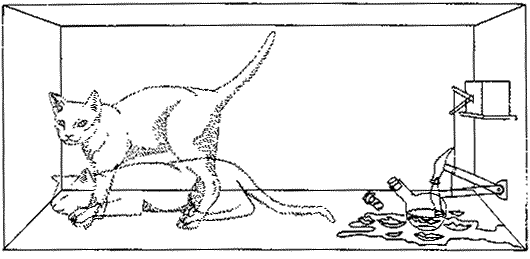
One of the very cool things that the His Dark Materials trilogy can do is really open up your imagination. The multiple worlds theory is one of the more interesting and applicable ideas in fantasy, spawning new ways to look at your favorite worlds. Anyone hear of the Schrödinger's cat paradox? The paradox states that every event is a branch point; for example if a cat is placed in a box for a day and dies, that only means it is dead in our universe. The cat is both alive and dead, even before the box is opened, but the "alive" and "dead" cats are in different branches of the universe, both of which are equally real, but which cannot interact with each other. So I started thinking about death in fantasy and how, according to Pullman, there a several universes in the HDM trilogy.

(rhetorical question) Is death an obstacle if the multiple worlds’ theory is used fantasy?

Contrary to the literature for LOTR, I believe Tolkien used this theory in Middle Earth. Gandalf fights the Bellrock and is mortally wounded doing so. He eventually dies of these wounds yet the “order” brings Gandalf back to life. The new White Wizard returns to fight for the fellowship and to destroy the ring. We all know of this, yet what realm does the order exist in and why does Gandalf feel like the years have passed by him? The simple explanation of this is that he spends time in heaven and then returns back a new man/wizard. But I’m gonna put a new twist on this idea. The White Wizard Gandalf might not be from the Middle Earth that the grey Wizard died in. On page 484 of the Two Towers in my book there is this quote:

“’Yes I am white now,’ said Gandalf... ‘But come now, tell me of yourselves! I have passed through fire and deep water, since we parted. I have forgotten much that I thought I knew, and learned again much that I had forgotten. I can see many things far off, but many things that are close at hand I cannot see. Tell me of yourselves!’”


Now, while there are many who read into this passage, and the passage on page 491 saying that he was “sent back naked,” believing that he was sent back from heaven to complete his job. However, what is heaven in this story but another dimension, another world that is layered upon Middle Earth? (Disregarding the Silmarillion that was published in Tolkien’s name post-humorously and was never fully described by Tolkien the way he intended, and forget about Iluvatar and the stories about his creation.) Taking into account the Schrödinger's cat paradox, this “Heaven” may just be a place where Gandalf never died. The Gandalf the White present in the Two Towers conveniently cannot remember specifics to come but knows the outcome now that he is here. He had to learn about the death of Boromir and the breaking of the fellowship from Galadriel because, in his universe with him present, Boromir may have never died and the fellowship was probably together. He may have created a crack in time and space and walked through to around the time he came close to death, knowing about multiple dimensions. This is a very “what if” scenario but nonetheless it is an enlightening experience when you think about.

Anyone else think this might be an option?

Tuesday, November 10, 2009

Tolkien and Binary Power

I have read almost all of Tolkien's work prior to the Lord of the Rings, saving his crème del la crème for a rainy day. Boy I was not disappointed! The plot may have moved slow and the dialogue/characters may have felt out of place at times, but other than that I had a very enjoyable reading experience. Maybe even too enjoyable to think critically about the text. So I took some time to look over my notes, gage the general flow of the plot one more time, and sort out the argument I have in my head regarding Tolkien. 

Lets speak of the way that Tolkien portrays women, my main irk. There were a couple conversations regarding the way women are portrayed in LOTR and they are all correct in their own right. The lack of any powerful female characters, aside from Eowyn and Galadriel, is naturalizing the idea in fantasy to associate power and heroism with the masculine. Spot on interpretation, I understand that point of view. Yet the absence of female characters does not show that female power and presence is unimportant. Yes, he may be playing into conventions (Hell, at the time he was writing, he may even be creating them) that place power in a masculine role but that does not mean women are written out of the equation. When looking closely at the characters and the plot, Tolkien may in fact be doing the exact opposite of what most believe. 

Tolkien's feminine characters serve as a counter to the traditional use of power, epitomized in Boramir and Faramir. Traditional power, seen in the Gondorians, is used in an effort to stifle evil in a physical way; they are characterized as brutish warriors who have a mastery over weapons and can kill Orcs, who are the epitome of evil, by the hundreds. Ultimately hubris, or pride, is tied with the traditional use of power; the more you kill the more powerful you become in the eyes of others. Pride bolsters the hero's power personally and publically, thus making the traditional use of power more associated with those characters that embody these masculine traits, which most of the time are men. 

Tolkien's feminine characters critique the physical, masculine power. Instead of pride and physical combat, the feminine qualities of the characters focus on love and healing. These characters offer an alternative that can be summed up as creation over destruction. Love and health are ultimately more important than the traditional power models relied upon by Aragorn or Gandalf. Frodo can only complete his task through the constant love and companionship of Sam and the health/nourishment provided by Galadriel in the form of the Lambas bread. Remember the plot of the novels: the big four (Gandalf, Aragorn, Gimli, and Legolas) must distract Sauron so that Frodo can bring the ring to Mount Doom and destroy it. When looking at the plot this way, the masculine power model is subservient to the feminine power model. 

So in the end, it may not be correct to say that Tolkien is sexist or promotes male over female. Tolkien may in fact be creating a binary power structure, one of traditional male qualities and one of female qualities. If in fact this is the case then we are left to wonder, why has fantasy seemed to use the masculine power structure more than the feminine? 

Monday, November 9, 2009

The Value of Tolkien's Lord of The Rings trilogy

Reading The Lord of The Rings trilogy has confirmed the place of Tolkien as my favorite fantasy author and as highly ranked among writers altogether. This is founded primarily upon the subject matter of his works but also includes the nearly tangible effect from his imaginative world building of Middle Earth, as well as the epic plot which is well-composed using various sub-plotlines. The story is effectively carried through the changing perspectives of multiple characters, contributing to their individual character development while further illustrating a well-rounded plot. I also enjoy Tolkien for his unique writing style. This was a matter of debate in our class, since there are those who enjoy the longer descriptions and the “slow pace” of the story at times and others who find it superfluous compared with other parts of the work. His influences from European mythology give his writing style unique character, reflecting the prose of Nordic mythology among others. Personally, I prefer his sometimes over-the-top and perhaps unnecessary emphasis on the description of surroundings and the inclusion of various historical details. It may have no concrete relation to the story itself, but it is still enjoyable to read since it is simply adding more to the world of Middle Earth.

I would also like to comment on the association of escapism with Tolkien. The entire genre of fantasy depends on escapism to some degree, as can be said with any other fiction reading; however I disagree that this association should carry a negative connotation. In my view, the stronger the power of the escapism, the more credibility is due to the work. Especially in the case of Tolkien, I do not think that the escapism in his works serves as grounds for criticism. I do not believe that Tolkien is entirely escapism, as The Lord of the Rings alludes to certain themes and ideas that are applicable to reality when reduced from its fantastical appeal. For instance, the idea of several races putting aside their feuds and disagreements, some of which have been deeply ingrained in their history, to unite for a common cause is an idea which is very significant to reality. Recognizing the greater evil puts the quarrels of the races into perspective and even contributes to the races beginning to understand each other and develop new relations. For example, Gimli, upon his visit to Lothlorien, is at first regarded with aversion and distrust, and likewise are his views of the Elves, but even by the end of his visit and continuing throughout the rest of the story, his relations with the Elves are strengthened, as can be examined through his bond with Legolas. One of Gandalf’s well-known aphorisms, “[a]ll we to decide is what to do with the time that is given to us” is also an example of a valuable idea which can be taken from the work. I do not believe that this is why The Lord of The Rings is so highly claimed, but I also think that these aspects contribute to the appeal of the work and should not be unmentioned.

Sunday, November 8, 2009

Grandpa Tolkien Passes Down Bedtime Storys to Future Generations

J.R.R. Tolkien has been considered by many to be the grandfather of the fantasy genre. His world of Middle Earth and his characters that inhabit the land have been an inspiration to many authors. R.A. Salvatore is one of today’s most respected fantasy authors. He has sold over 10,000,000 books, been on the New York Times best-seller list several times, and has had his books translated into fourteen different languages. R.A. Salvatore lists Tolkien as one of his influences. Salvatore changed his major in college to computer science to journalism after he had been given a copy of Lord of the Rings. The Spearwielder’s Trilogy was dedicated in memory of Tolkien for inspiring Salvatore. It is easy to see influences of Tolkien in R.A. Salvatore’s work, especially in The Cleric Quintet.

The Cleric Quintet centers on a cleric, Cadderly. Cadderly is a brilliant thinker, easily translating and memorizing complicated text. He is a scholar and makes an unlikely hero like Frodo Baggins. Neither character is a warrior with the knowledge of battle to take on evil. Cadderly, although a master at creating war technology, is no fighter. If anyone looks like the likely hero it is his girlfriend, Danica, who can wrestle people several times her weight, break boulders with her head, and even stop the beating of her heart and remain alive for a time. Frodo is not educated in battle and would be considered too small by many to take on an enemy (he can't do much but kick evil in the shin, although Merry and Pippin prove this wrong later). Both Frodo and Cadderly must leave the only home they have known to go fight evil. Frodo must leave the Shire. Cadderly leaves the Edificant Library where he has lived since he was five. Neither Frodo nor Cadderly are able to stay and enjoy the victory they helped accomplish. Frodo has been too hurt by the burden of the ring. Frodo says, “It must often be so, Sam, when things are in danger: some one has to give them up, lose them, so that others may keep them.” The act of destroying the evil in the Cleric Quintet literally steals the years from Cadderly. A man who was in his early twenties has been turned into an old man. His destiny after is to rebuild a place like the Edificant Library that was destroyed but Cadderly will only live long enough to see it built before he dies. He must lose everything, his youth, his friends, and his love, to defeat the evil and will not be there to enjoy it.

Both series have a fellowship. The Fellowship of the Ring is made up of men, elves, hobbits, dwarves, and a wizard. In the Cleric Quintet it is made up of men, dwarves, and elves. Just like in Lord of the Ring, the elves and dwarves do not get along in the beginning, although they later find respect for each other while in battle. This mirrors the relationship between Gimli and Legolas. R.A. Salvatore uses the two dwarves, The Bouldershoulder bothers: Ivan and Pikel, as comic relief in his book. They are no where near as dignified as Gimili. Ivan fills the role of a normal surly dwarf but his brother Pikel dyes his hair green in hopes of being like the druids and only speaks in sounds like "oo oi" and "boom". The brothers have competitions to kill the most orcs which often ends in each brother exchanging insults which leads to rough housing. The elves still hold themselves above the other races being proud of their heritage and the forest. R.A. Salvatore clearly follows the relationships and types of races as Middle earth (including evil orcs).

In the Cleric Quintet, Elvin forest Shilmistra comes under attack from orcs, giants, and orogs. Cadderly and his friends are quickly running out of ways to defend the forest, especially since evil has started to set the forest on fire. In a last defense Cadderly translates an ancient Elvin text that will bring the trees to life. (Sound familiar?) The trees come to life and fight to save the forest alongside Cadderly and his friends. This echoes the Ents except that these trees are “alive” but don’t have a personality like the Ents. So the trees in the Cleric Quintet are like the ones the Ents herd.

The comparisons don’t end there. There is the Barad-dur, “the dark tower”, which could easily be compared to Castle Trinity, the home of evil in the Cleric Quintet. It’s easy to see the influences and many people believe that R.A. Salvatore creates convincing worlds that are similar to Middle Earth. Tolkien influence is still continuing to be seen in works by authors today. My guess, Tolkien will continue to inspire authors for years to come.

Monday, October 26, 2009

There and Back Again: An Addict's Tale

The Lord of the Rings covers many various themes throughout the trilogy: brotherhood, spirituality, good vs. evil. In class we covered many of these themes and beat them to death in discussion and in-class writings. We never really touched on a theme that I found to be prominent throughout the three books: addiction. Tolkien claims to not have any sort of premeditated social comentaries inserted into the books but I don't know if I can possibly ignore the fact that the Hobbits are definitely going through problems that seem like drug addiction.

Bilbo's reaction to Gandalf's taking of the Ring and making sure it goes to Frodo is one of the most prominent parts of the series that touches on addiction. According to helpguide.org , a non-profit health website, some mental and emotional signs of addiction include "increased irritability, agitation and anger, paranoia, delusions, and lowered threshold for violence." During the scene I've chosen from The Fellowship of the Ring Bilbo seems to have many if not all of these symptoms towards Gandalf. He becomes suspicious and annoyed of Gandalf even suggesting leaving the Ring behind for Frodo to watch over.

The more the Ring is put on Frodo it seems to consume him more and more. The burden becomes heavier both mentally and physically. Gollum is a character that seems to be the user so consumed by his addiction that it is all he cares about. He killed for it and is willing to do anything for it, much like an avid drug addict.

This theme never deteriorates but is prominent even to the destruction of the Ring. Frodo journeys for three books to destroy his addiction, but in the end he seems to "relapse". He does not let go of the Ring even when he's about to finish his task and can't bear to part with it. It is only Gollum's strong lust for the Ring that destroys it.

I may be going out on a limb with this blog, but I've always felt this theme was not only prominent but also one of the stronger themes of the story. Tolkien may claim to have no premeditated themes or societal reflections but I don't know if I completely believe him.